
29 Grand River Street South
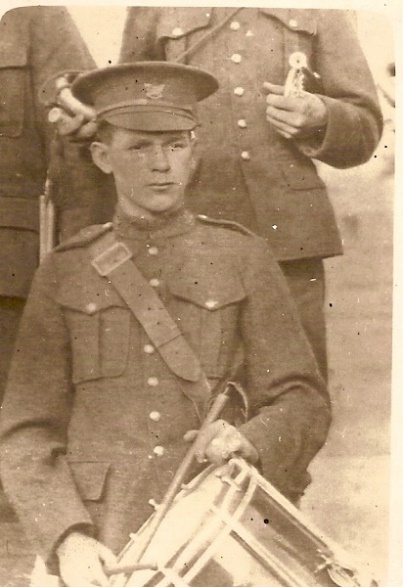
Lance Corporal Stanley Rowe
Stanley Rowe (or Row - Family members have used both spellings) was born August 3, 1899, in Nottingham, England, the 12th child of Walter Row Sr. and Elizabeth Allgood. The family lived at 29 Grand River Street South. Stanley enlisted, or tried to, on May 27, 1916, with the 215th Overseas Battalion stating his date of birth was August 3, 1897, and that he was employed as a knitter, probably at Penmans. He declared that he was a member of the 25th Brant Dragoons. He was discharged on October 16,1916 when his real age was discovered and his unit sailed on April 29, 1917 without him.
Stanley re-enlisted in Hamilton on January 7, 1918, at 18 and joined the 2nd Depot Batallion of the Central Ontario Regiment. At this time, he was working as a shoe repairer in his father’s shop on Grand River Street North. He was a member of the 25th Brant Dragoons band and had served in the 215th Battalion for five months. His fitness level was A-4 for men under 19 who would be A1 or A2 when aged 19.
On September 28, 1918, Stanley was transferred to 259th Battalion, Canadian Rifles. On October 28, 1918, he was stationed in Edmonton when he was admitted to hospital with influenza, a worldwide epidemic at the time, and rejoined his unit on November 9, 1918. Stanley went overseas with his unit on December 26, 2018 aboard the S.S. Protesilaus to serve with the Canadian Siberian Expeditionary Force Siberia (CSEF), a Canadian military force of 4,192 soldiers sent to Vladivostok ,Russia, during the Russian Revolution that started in 1917. Their goal was to bolster the Allied presence, oppose the Bolshevik Revolution, and attempt to keep Russia in the fight against Germany. The advance party of Canadian troops left Vancouver aboard the Royal Mail Ship Empress of Japan, reaching Vladivostok on October 26, 1918.
The main body of the CSEF arrived in Vladivostok in mid-January 1919, aboard the ships Teesta and Protesilaus, which had departed from Victoria on December 21, 1918. They had been delayed by a mutiny of two companies of mainly French-Canadian troops in the 259th Battalion. The Protesilaus also faced difficulties reaching Vladivostok, losing a propeller off the Russian coast when it got stuck in the ice. There was strong criticism of the Russian campaign from labour unions and the public, including farmers in the Prairie Provinces, and from the Toronto Globe newspaper. Domestically, the Siberian expedition was presented to the public as a trade and economic opportunity. After the Armistice, however,
domestic opinion turned against foreign involvement, particularly with conscripted troops, many of whom were French-Canadian.
After the main force of Canadians arrived in Russia in January 1919 it was decided to bring them home. The government refused to allow them to move to the Front where they would come into conflict with the Soviets so they stayed in Vladivostok, undertaking routine drill and policing duties in the volatile port city where even there they were not safe, as Soviet partisans had started to attack Allied troops. Canadians were ordered to arm themselves at all times. On April 21, 1919, the remaining Canadians, including Lance Corporal Stanley Row, boarded the SS Monteagle and sailed for Victoria, ending the Canadian presence in Russia. On June 1, 1919, the last Canadians to leave dedicated a monument to the 19 Canadians who died in Russia.
On May 9, 1919, Stanley had a medical exam in Vancouver on leaving the service of 259th Battalion and was taken off strength at the Military District 11 British Columbia (Victoria). On May 28, 1919, he was transferred to District Depot 2, Toronto and then was sent to Toronto General Hospital on June 19, 1919. He was diagnosed with chronic tonsillitis and underwent a tonsillectomy. Lance Corporal Stanley Rowe received his final discharge on July 23, 1919, in Toronto.
After the war, he became an estimator for building contractors. He met his wife Queenie Shelton through the Anglican Young People’s Association in Windsor while he was working there and they married in September, 1927. During the Second World War, Stanley served in the Royal Canadian Air Force as an estimator for hangars, barracks, and other military buildings on the east and west coasts. He was attached to #9 Construction Maintenance Unit in Vancouver, BC. After the war he continued working as an estimator until retiring. He and Queenie retired to Paris, living on Charles Street, a short distance from his boyhood home.
Lance Corporal Stanley Rowe died at the Willett Hospital July 11, 1988 and is buried with his wife in the Paris Cemetery.
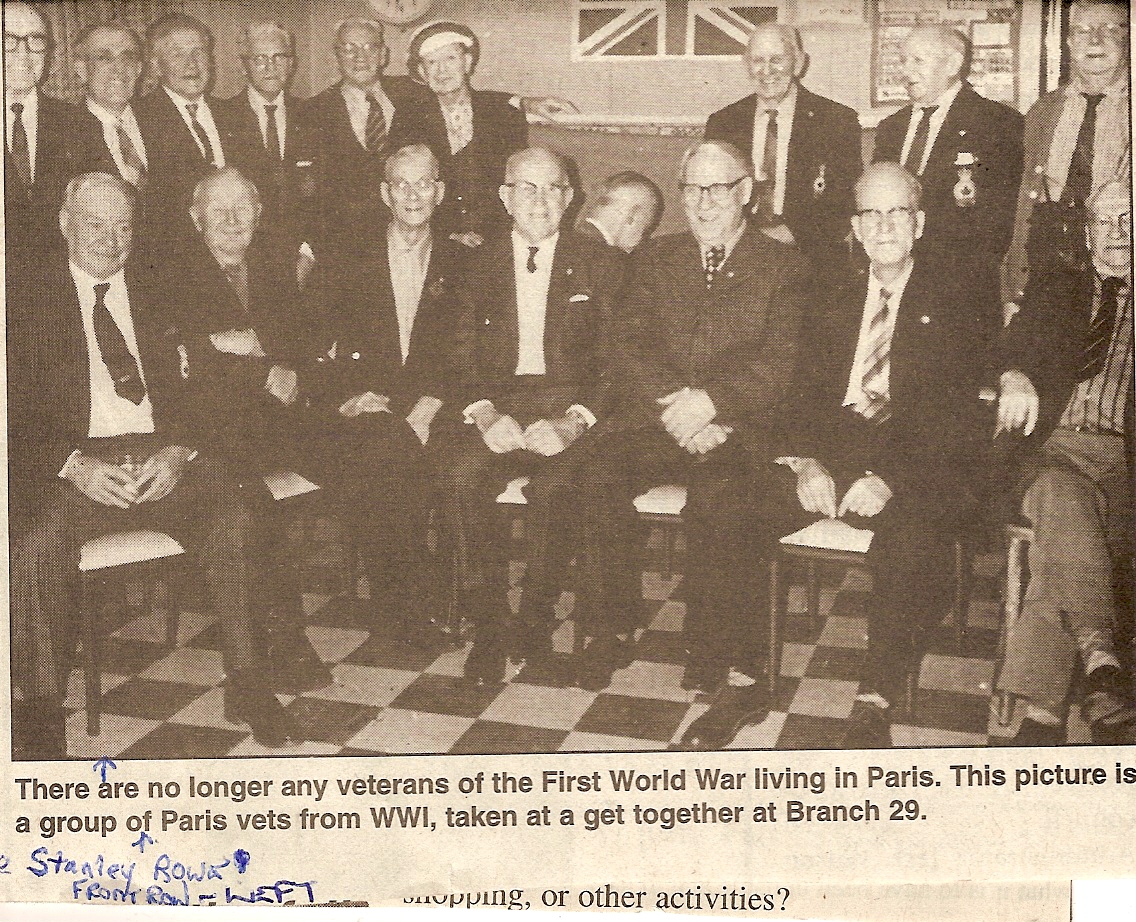
(This is a photo of First World War veterans taken at the Paris Legion, Branch 29 in 1970. Stanley Rowe is seated on the left.)