
29 Grand River Street South
Private Walter Rowe
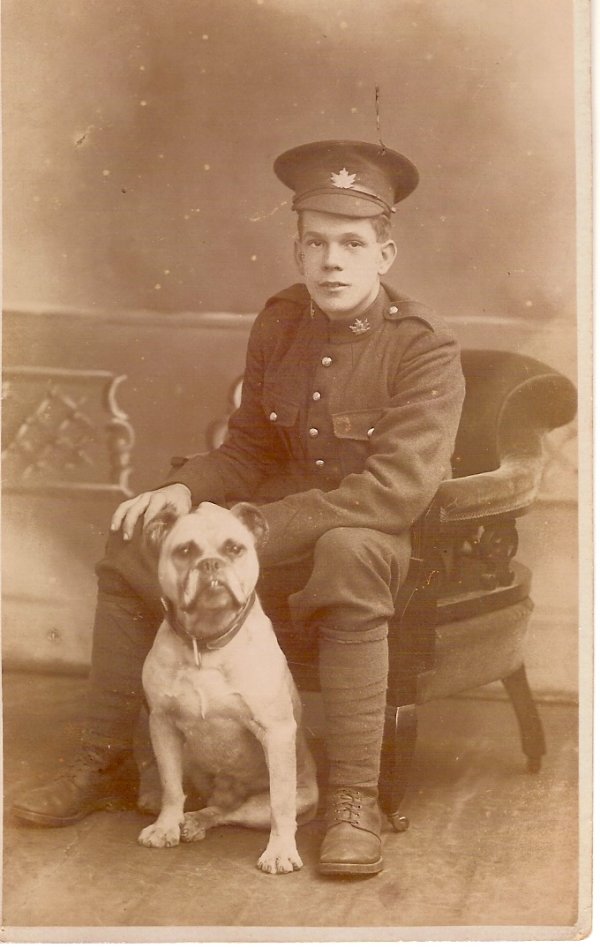
Walter Rowe was born on May 3, 1897 in Nottingham England the son of Walter Rowe Sr. and Elizabeth Allgood. He emigrated to Paris with his parents in 1907. (Members of the family have their surname spelled either Rowe or Row.) When he enlisted, he had three brothers and five sisters, and they lived at 29 Grand River Street South. He was a member of the St. James Anglican Church choir as well as the Bible class. He first tried to enlist when he was too young, was turned away and later returned when he was of age. At the time of his enlistment, he was working as a shoe repairer in his father’s shop on Grand River Street North. He attended Paris military camp in 1915 with 65 others, and in July 1915, he enlisted with the 38th Dufferin Rifles. He later transferred to the Canadian 24th Battalion (Victoria Rifles of Canada) in the Canadian Expeditionary Force. The battalion arrived in France in September 1915 and fought in the Ypres Salient.
The Ypres Salient was a heavily contested bulge in the Allied lines around the city of Ypres, Belgium, during World War I, where German forces held advantageous high ground on three sides. This area saw intense fighting, including the first major use of chlorine gas in April 1915, shortly before Walter arrived, during the Second Battle of Ypres, in which Canadian troops earned recognition for their determined defence. The Ypres Salient became a symbol of brutal warfare, resulting in a desolate landscape and numerous casualties on both sides. The battles in the Ypres Salient were characterized by harsh trench warfare in difficult conditions due to the mud and low-lying ground of Flanders. The battle also led to Canada's first major poem, "In Flanders Fields" written by Canadian officer John McCrae, and influenced the national policy of keeping Canadian troops together as a unit.
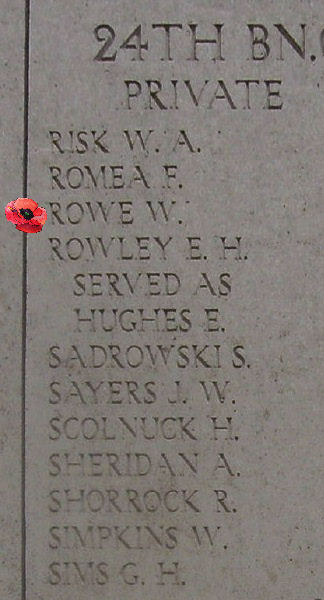
Walter was killed in action on June 16, 1916. He was 19 years old. In the horrifying and desolate conditions of the battlefield, Walter’s body was never recovered. His name can be found inscribed among the other fallen soldiers of his battalion at the Menin Gate Memorial, situated at the eastern side of the town of Ypres (now Ieper) in the Province of West Flanders, on the road to Menin and Courtrai. It bears the names of 55,000 men from the British Empire who were lost without trace during the defence of the Ypres Salient in the First World War. The dead are remembered to this day in a simple ceremony that takes place every evening at 8:00 p.m. All traffic through the gateway in either direction is halted, and two buglers (on special occasions four) move to the centre of the Hall and sound the Last Post. Two silver trumpets for use in the ceremony are a gift to the Ypres Last Post Committee by an officer of the Royal Canadian Artillery, who served with the 10th Battery, of St. Catharines, Ontario, in Ypres in April 1915.
His parents are buried in the St. James Anglican Church cemetery and Walter’s death is memorialized on their headstone. In 2006, Brant County, honouring members of the community who gave their lives in the First World War, named a new street, Row Lane, after Walter.