
Private William George Larin
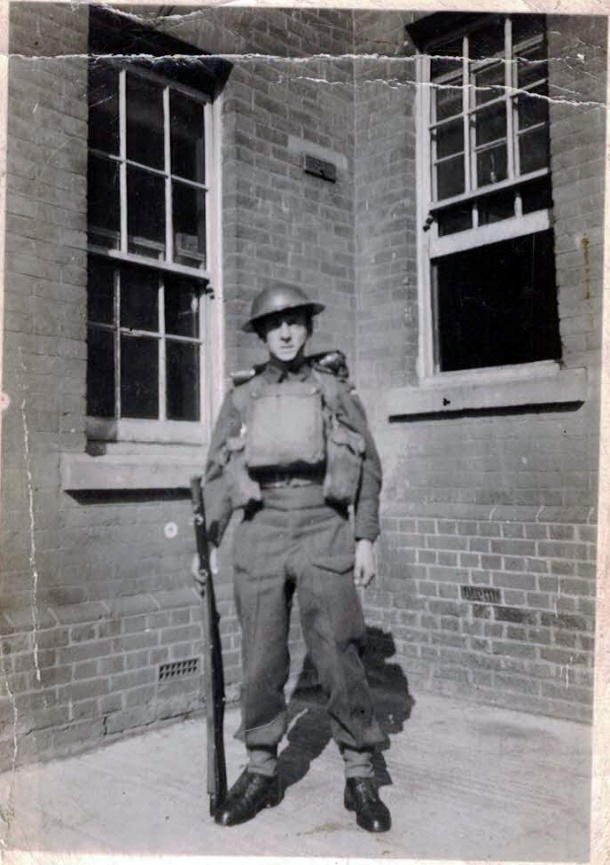
Bill Larin, the son of Napoleon and Catherine Larin, was born in 1915. The family lived in the US for several years and returned to Paris when Bill was a teenager. The family lived at 44 Willow Street.
Bill served with the Royal Hamilton Light Infantry (RHLI) during the Second World War. August 19, 1942 was the date of the disastrous raid on the German-occupied French port of Dieppe. The operation involved over 6,000 Allied troops, mainly Canadians, with the aim of testing the feasibility of an amphibious assault in Nazi-occupied Europe. The RHLI was mobilized as a key amphibious assault force. The raid was a costly failure, resulting in heavy casualties and demonstrating the strength of German defences. Bill Larin took part in that raid.
The explicit operational mandate for the RHLI was to storm White Beach and secure the main beachfront in front of the town of Dieppe. Then they were to neutralize fortified German strongpoints inside the beachfront casino. Then they were to coordinate with the late-arriving Calgary Tanks to fight through the town, secure exits, and clear a path inland to capture the airfield at St. Aubin. None of that happened. Out of 582 RHLI members who landed on the main beach, only 211 returned to England. 197 were killed or died of their wounds. 175, including wounded, were captured. Private Bill Larin was one of those prisoners of war.
After intense combat around the town's casino and promenade, he was among the hundreds of RHLI soldiers forced to surrender on the beaches when evacuation became impossible. German guns were sinking rescue boats as they came to shore and when they tried to sail back from the beach. In 1992, Bill was interviewed about his military service and described the situation he and his fellow soldiers were in:
“The Germans had raised the beach so that we were in the direct line of fire crossing the wire. We headed for the seawall and took shelter there. I don't know what our casualties were, as I was late getting through, and lost my section. The beach was covered with stone, and the tanks threw their tracks and were mired on the beach. They acted as pill boxes and protected us to some extent. We were pretty well pinned down, under heavy mortar and artillery fire. Above the seawall was a wide promenade, and facing the promenade, buildings, which were full of machine gunners.
You didn't dare look over the seawall, as you would've been fair game for snipers. Boats had a tough time getting in, and a worse time getting out. A lot of them were hit on the way out. I'm sure that the Germans had everything ranged. They were very accurate with their fire. They would hit a boat, you would see heads bobbing around, then nothing. A large German bomber came over and bombed the boats. The tide came in and washed a lot of bodies into shore, and the water was red along the beach, a terrible sight. Some of the mortar and artillery fire sounded like an express train going through. It was pretty scary and I said many a prayer that day. We didn't have much of a chance, with about 65 miles of water on one side, and machine guns and artillery fire on the other. We got word to evacuate to a T.L.C. (Tank Landing Craft) on the beach. I crossed the beach to the boat, seeing a lot of people and few boats. The tide coming in squeezed all of us into a smaller area. The Germans were firing away, and the casualties were heavy. I went back and holed up behind a tank. Things were hopeless, and the white flag finally went up. If it hadn't, we would have all been killed, I'm sure, as the Germans were just above the seawall. The battle had lasted a long nine hours.”
The POWs were marched inland, and on August 29, 1942, they boarded a train that would take them on September 3 to Stalag VIIIB, a POW camp near Breslau, Germany, between Czechoslovakia and Poland. The camp was mainly for British prisoners and main base for about 25,000 prisoners. In his memoir, Bill gave a detailed depiction of life in a POW camp. He described the hunger and poor food as well as the primitive accommodations, the cold and the mud, and the harsh punishments by the guards. But he also spoke of the camaraderie among the British, New Zealand, Australian, South African, Indian, Palestinian and Canadian soldiers. He remembered the Red Cross parcels they received. And he spoke of the two escape tunnels dug by Canadian engineers. Forty prisoners escaped but most were caught. There was a rumour that a few made it to Sweden.
In January, 1944, they were transferred to Stalag IID, about 25 miles from the Baltic Sea, across from Sweden. Prisoners were forced to work on a large potato farm, but the Germans did not like the way the Canadians worked, so they were replaced by Italians, and the Canadians worked in a sawmill. By this time, the Germans were getting nervous. The Russian Army was advancing from the east and hundreds of American bombers flew overhead at night. In February, the prisoners were marched out of the Stalag toward the west. They were guarded by soldiers who looked no older than 15 or 16 years old. They had to scrounge for food when they could and stayed over on farms at night. Eventually they crossed the Elbe River and ran into the American 9th Army. From there they were shuttled back to England where they were fed, deloused and taken to their home camps. Bill said that “when we hit the coast of England, all the lights were on – what a beautiful sight.” He sent a cable to his parents in Paris and to Mary Margaret Green Hutcheon, his fiancée in Aberdeen, Scotland.
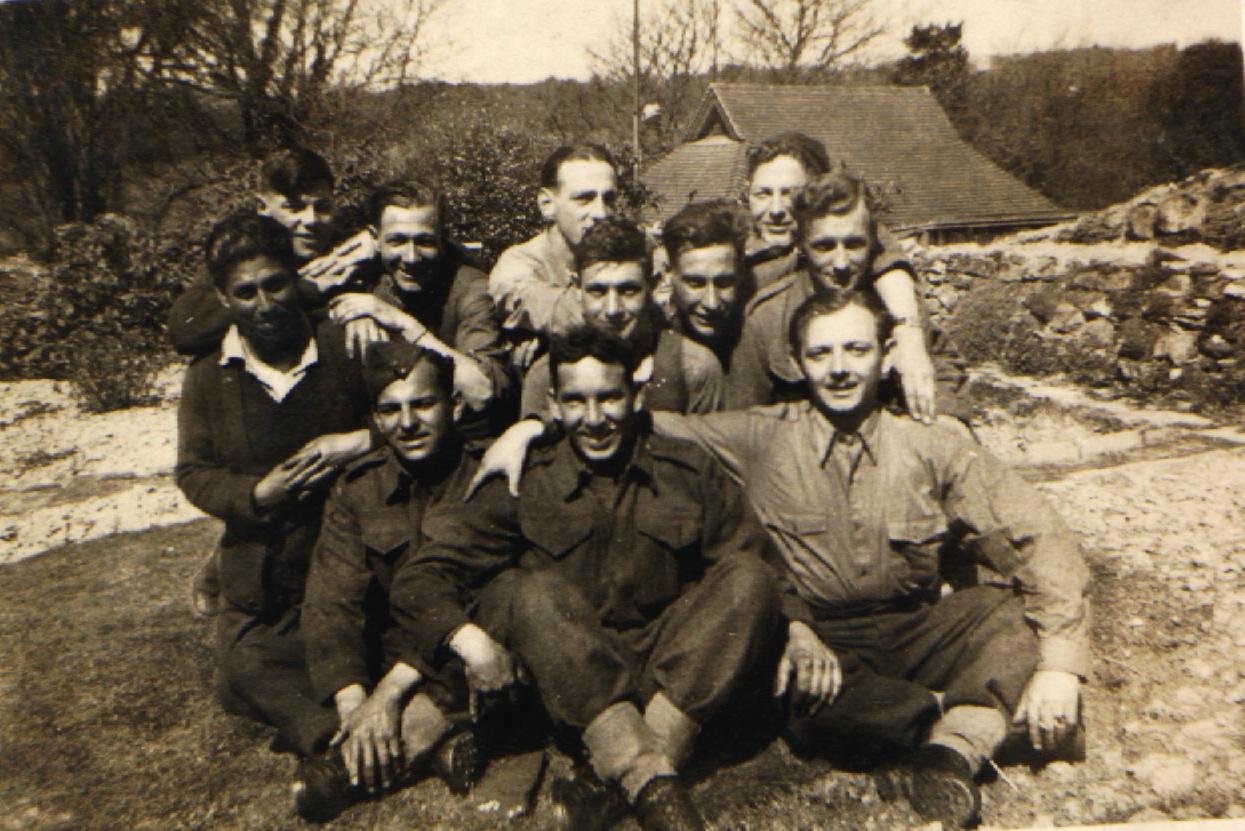
Bill ended his memoir with the names of his fellow soldiers in the Royal Hamilton Light Infantry who died at Dieppe:
ALF GIBBONS - 18 YEARS
BILL PRINE - 23 YEARS
HARRY GIBBONS - 21 YEARS BILL SHARPE - 22 YEARS
GEORGE CRUIKSHANK - 22 YEARS
HARRY PILLEY - 22 YEARS
Two others, TEDDY JENNER, 24, and GERALD ARTHRELL, 26, got back from Dieppe, and were killed in France, in 1944. We should never forget their sacrifice. Our flyers, sailors, and soldiers were put in some terrible situations, and paid a heavy price in killed and wounded. Remember, we were all volunteers, and were very proud to serve our country.
Bill was demobilized and returned safely to Canada. His wife, Mary, came to Canada in 1946 from her home in Aberdeen. Bill worked as a knitter at Penmans, probably until the strike in 1949. He studied to become an electrician but for some reason abandoned the effort. He later worked as a laborer at Consolidated Sand and Gravel, finishing as a weigh clerk before he retired.
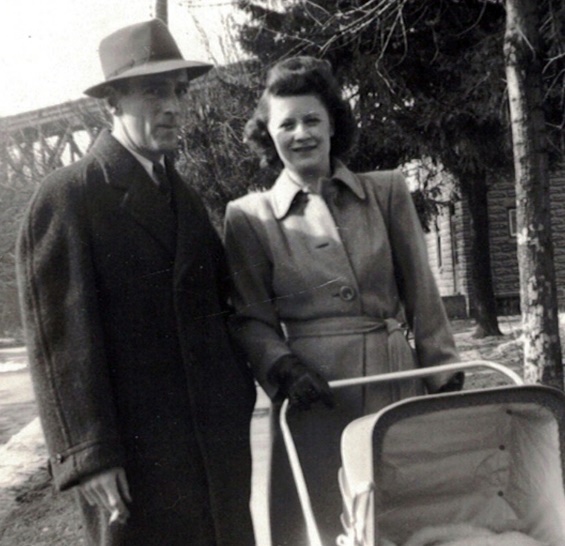
The couple had four sons, Michael, Martin, Neil and Rick. He took them fishing when they were young. Bill had a garden in the backyard that he attended to during the summer months. He was involved in Little League when it first came to Paris and coached one of the teams in the first year. He was a school board member at Sacred Heart School for a year. Bill was a member of the Paris Legion and always participated in Legion events and Remembrance Day ceremonies.
Private William Larin died at the age of 84 in 1999. He is buried with his wife in the Paris Cemetery.