
Willow
Private Napoleon “Poly” Larin
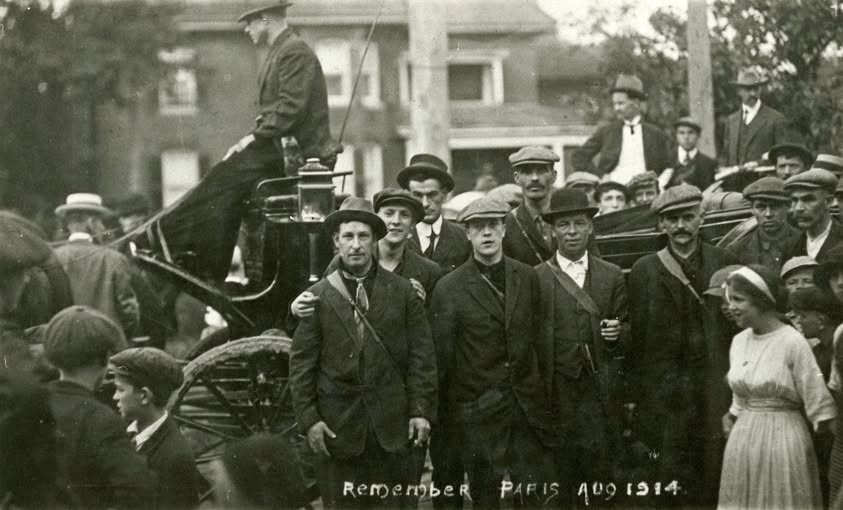
Napoleon Larin was born in Montreal, Quebec on November 5, 1885. He enlisted in Brantford on August 8, 1914, with the Dufferin Rifles among the very first men to enlist in the First World War. At the time, he was married to Catherine McCaffery and was employed as a knitter at Penmans No.2 Mill. They lived on Willow Street at the time. They attended Sacred Heart Catholic Church. Napoleon was 28 years of age. (He is the man on the left, facing the camera.)
Napoleon transferred to the Canadian Overseas Expeditionary Force, G. Company, 4th Battalion, on September 22, 1914, at Valcartier, Quebec. He sailed from Quebec on the S.S. Tyrolia on October 3, 1914, with the first contingent of the Fourth Battalion.
He was admitted to No. 12 Stationary Hospital at Rouen on March 11, 1915, for Inflammation of connective tissue, often caused by trench conditions or blunt trauma, and discharged on March 16 to the Convalescence Depot in Rouen. He was wounded again on April 29, 1915, and admitted to No. 11 Stationary Hospital in Rouen, this time for a wound to his left thigh and was transferred to Canadian Base Detail, Rouen on May 3, 1915.
Napoleon’s experience with the horrors of trench warfare had only begun. The 4th Battalion had been fighting in Ploegsteert, Belgium, a village at the very south of the area associated with Ypres, though technically not part of the Ypres Salient. It is only about two miles north of Armentieres, close to the French border and eight miles south of Ypres. Interestingly, it was the most famous and documented site of the event during the Christmas Truce of 1914, where roughly 100,000 British, French, and German troops participated in the informal ceasefire. On Christmas Eve 1914, German troops placed candles and small trees along their trench lines and began singing carols like "Stille Nacht" (Silent Night). Allied soldiers responded by singing their own carols across the frozen No Man's Land. This spontaneous exchange of music quickly led to men crossing the lines to share food, cigarettes, and play casual games of football.
Unfortunately, there was no sign of this humanity seven months later. The fighting that took place in the Ypres Salient came to typify the horror and futility of trench warfare in World War One. Ploegsteert was in Wallonia, not far from Flanders which was made famous, or infamous, in the poem by John McCrae, “In Flanders Fields”. Canadian soldiers often had trouble pronouncing the names of places where they fought. Ypres became Wipers; Ploegsteert became Plugstreet.
The battalion was fighting to regain ground that had been lost due to a German poison gas attack. Napoleon himself explained the circumstances of his injury:
“I was working at a loophole firing on a German working party behind their lines. I could not tell very well what results I was getting. An old house, which I believed to be deserted, was between the lines and from that location a German sniper spotted me. He could not have been farther away than 50 yards, but he put one through the two inch loophole and got me through the right jaw. My discharge paper says it happened on July 3, so I guess that proves it.”
On July 7, 1915, Napoleon was reported to have been killed while on sniper duty on July 3, 1915, but on July 5, he was admitted to No. 20 General Hospital in Etaples, for a gunshot wound to his head and fractured lower jaw on the right side. The initial hospital examination notes revealed that he had received a horrific injury. Fate had not been on his side. Two days after he was injured, the Royal Montreal Regiment relieved the 4th Battalion in Ploegsteert Trenches on July 5.
He was transferred on July 12, 1915, to England to the Wharncliffe War Hospital in Sheffield,England, a major military medical facility. It was established in March 1915 when the South Yorkshire Asylum was loaned to the War Office and the civilian mental patients were evacuated to other asylums across the North of England. The site was transformed into a 1,500-bed military hospital which closed in 1920 and reverted to a psychiatric hospital. Several surgeries were performed on him there.
On October 28, 1915, he was transferred to Canadian Convalescent Hospital, in Monks Hood, Kent, a 650-bed tented facility with house included which was operated by the Canadian Army Medical Corps (CAMC), from May 1, 1915, to August 1, 1918, where it provided crucial rehabilitation for wounded Canadians prior to being returned to active duty or returned to Canada. A day later he was discharged to the Military Hospital in Shorncliffe, where he was assessed on November 2nd. He was diagnosed with absence of part of lower jaw and immobility to abduct arm at his shoulder joint.
He was discharged as permanently unfit. He was discharged from his unit on November 11, 1915 and sailed to Canada on the S. S. Corsican on November 19. The Brantford Expositor reported on his reception back in Paris: Private Napoleon Larin was given a rousing reception on his return from the front Monday. When the train from London arrived he was met by mayor Patterson and other prominent citizens, besides the Paris members of the 125th Brant Battalion, and escorted through the principal streets to his home, his welcome being very enthusiastic.”
Napoleon’s return must also have made clear to the people of Paris some of the horrors of warfare. His injury was life-altering and it took many years of attempts to make his life easier. Napoleon was transferred to Toronto General Hospital in February, 1916 where a rib bone graft was performed. Due to suppuration, it was removed. Three months later a second attempt at bone grafting was done at Brantford General Hospital but 8 weeks later it was removed for the same reason. On April 27, he was living at home in Paris, but he was taken to the Central Military Convalescent Hospital in Toronto on November 24, 1916, and then back home. In October, 1919, he was admitted to military hospital at Ste. Anne de Bellevue, Quebec where he was examined and X-rayed and dental restoration and reconstruction began on November 6, 1919. On Nov. 14, the results were found to be in good occlusion held in position by flange and socket apparatus. Nov. 20 – he was told to come back in two months for further dental work. He was admitted to Davisville Hospital, Toronto, on November 26, 1919, then transferred on Feb, 10, 1920 to Dominion Orthopaedic Hospital in Toronto where he underwent treatment until August 18, 1920.
In 1921 the phone book showed they still lived on Willow Street. However, his wife was from Vermont and they moved back to her town and family for several years, but eventually returned permanently to Paris in 1933. In 1939 a Voters List had them living at 16 Smith Street in Paris. In 1941, the family lived at 3 Broadway Street East. which was the site of the Paris Armoury. He was employed as a caretaker there until his retirement.
At the start of the Second World War, the Dufferin and Haldimand Rifles of Canada mobilized for active service on May 24, 1940. It was later redesignated the 1st Battalion, the Dufferin and Haldimand Rifles of Canada. It served in Canada in a home defence role as part of the 17th Infantry Brigade, 7th Canadian Division. The Ministry of National Defense had established a force to be known as the Veteran’s Home Guard for the adequate protection of military property on the home front, freeing younger men for overseas duty by replacing the Canadian Provost Corps, the military police of the Canadian Army. Members of the Home Guard guarded facilities such as the 40 internment and POW camps operated across Canada during WW2. The battalion was disbanded on March 8, 1945. Napoleon Larin had been a member.
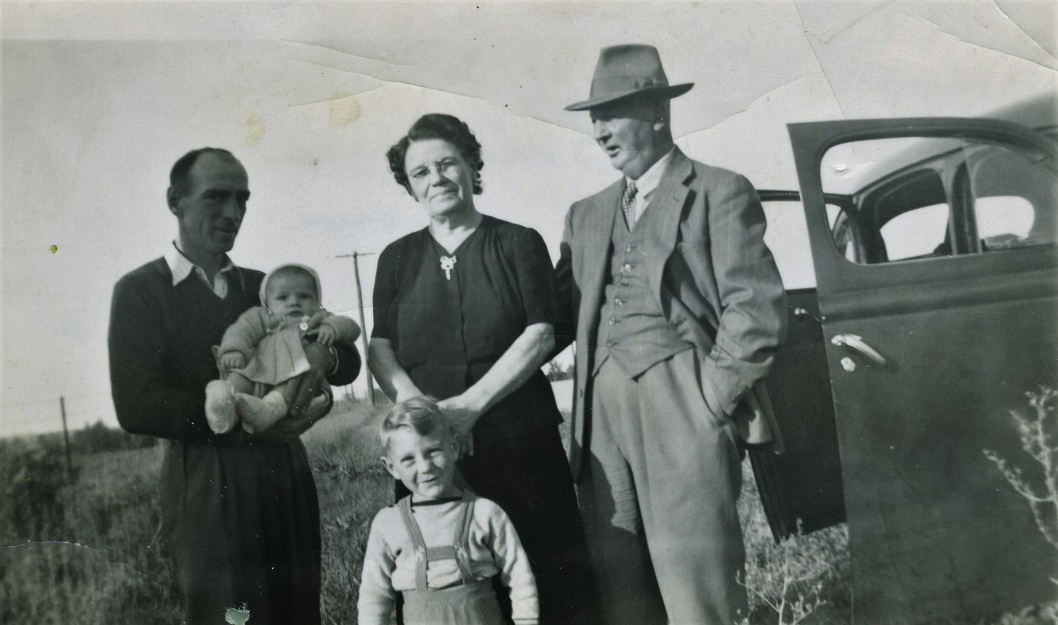
Private Napoleon Larin died on October 12, 1952, at Sunnybrook Hospital, Toronto, where he had been for six weeks due to effects of his war injury. He was buried with military honours at the Sacred Heart Catholic Cemetery in Paris. He was 66 years of age.