
Grand River
Private Sinclair Knill
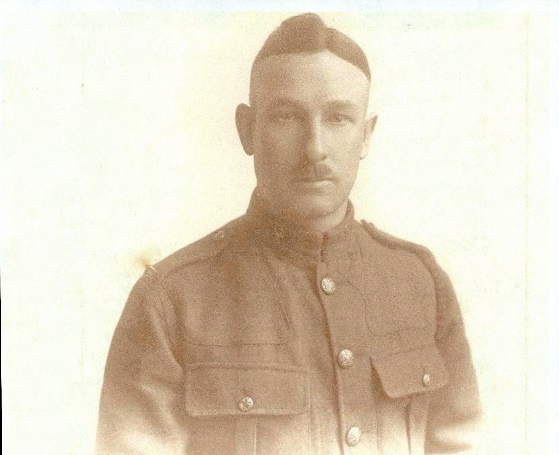
Sinclair Knill was born in Falkland on January 3, 1885. He was the son of John and Mary Knill. John Knill was a farmer at the time, but by 1911, the family had moved to Grand River Street in Paris. Sinclair had two younger brothers and a younger sister. The family attended the Paris Baptist Church.
Sinclair was 29 years of age when he enlisted at Valcartier with the 4th Battalion, 1st Regiment. He identified his occupation as chauffeur, but he already had some military experience. He had been with the 29th Waterloo Regiment for two years. In October to November,1903, he attended the Royal School of Infantry in London, Ontario and received a certificate of passing Military Instruction, Grade B.
It is not clear when he went overseas, but he appears to have served in Belgium with the Canadian Army Service Corps (CASC), which was responsible for transport, supply, and logistics in the Canadian military. The CASC was created in 1901 and formed from the British Army Service Corps model. During the First World War, CASC units supported the Canadian Expeditionary Force (CEF) and the field army with food, ammunition, engineering materials, and motor transport. While not a traditional "infantry regiment," it operated as vital support units, like battalions and companies, providing essential services like vehicle repair, bridge building, and even training army cooks.
Presumably, Sinclair was performing this role when he was reportedly gassed during the Second Battle of Ypres, which was fought from April 22 to May 25, 1915, for control of the tactically valuable high ground to the east and the south of the Flemish town of Ypres, in western Belgium. The Second Battle of Ypres was the occasion of the first mass use by Germany of poison gas on the Western Front.
Sinclair wrote a letter home about his experience with trench warfare which was received in June, 1915, shortly after the Battle of Ypres. He wrote: “Just before daylight we were sent in across an open field to support a territorial regiment. It was raining, and everybody was so worn out. We extended and walked down across the field. Although the bullets and shells were coming thick. Everybody was too tired to double, and didn’t care if they did get hit. We dug ourselves in and watched the “Terriers” go up. They were all young fellows. No old soldiers to steady them, but they were very fine fellows. Even their officers were inexperienced. After they got up a way, they had a bad case of stage fright, and broke, coming back in disorder. It was a ticklish business for us, but our three remaining officers saved it by going out and rallying them. They took them up and showed them how to dig in and got them spread out. They took heart, and the following day made a brilliant charge.”
Sinclair was transferred to Division Supply Column on May 22, 1915. He was transferred again to a Canadian Base Depot on January 4, 1917. On January 12, he was transferred once more, this time to the Canadian Training Depot in Shorncliffe, England, where he was discharged as being no longer fit for duty, presumably as a result of being gassed. On January 22, he was declared fit to travel, and he sailed home on the Grampian of February 20, 1917 and was discharged in Canada when he reached home.
On April 29, 1918, Sinclair, now 33 years old, married Ivy Gladys Armstrong. They had a son Jack, born in 1926 and a daughter Holly Jane, born in 1930. On June 26, 1924, he crossed the border into the US at Port Huron. He declared that he was an insurance agent and was entering the US for a five-month visit. However, in the US Census of 1930, he was living in Long Beach, California and working as a pipe fitter. On September 10, 1940, he applied for permanent US residence. By this time Sinclair was divorced and working as a tool room keeper at a shipyard. In 1942, when he received his US draft card, he was living in Los Angeles and working for Bethlehem Steel in the Shipbuilding Division. His wife was still in Long Beach.
Sinclair Knill died in Long Beach on December 2, 1947 after a brief illness. He was 62 years old. Before leaving Paris, he had acted for some time as secretary of the Great War Veterans Association, which predated the Royal Canadian Legion. He was a lifelong member of the St. John’s Masonic Lodge in Paris and also a member of the Almalaikiah Shrine in Los Angeles.