
12 Alexander Street
Lieutenant-Colonel John “Jack” Howard Knill
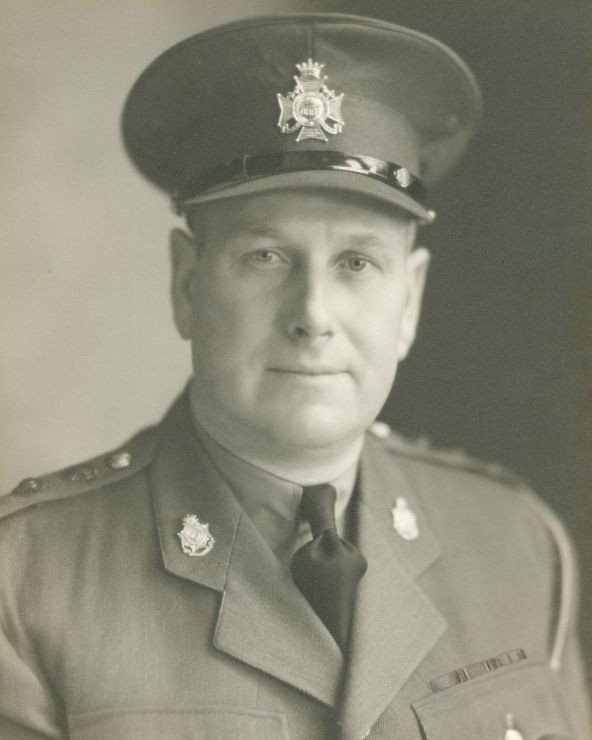
Jack went to Paris High School. Prior to enlisting he had been employed as a clerk with the Bank of Commerce from August 26, 1912. His attestation paper, which was signed by him in Valcartier, PQ, on September 18, 1914, with his oath taking on Sept 22, 1914, was stamped 1st Battalion. He was declared medically fit for the Canadian Over-Seas Expeditionary Force. He sailed to England on S.S. "Laurentis" on October 4, 1914 as a Private in the 1st Divisional Cyclist Company.
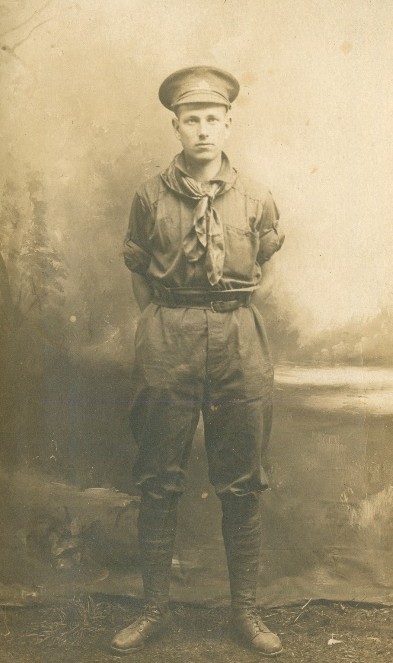
Jack spent three years in France. It must have been immediately apparent in the muddy trench warfare that a cyclist company would be of little use. Upon arrival in France, the cyclists were often employed in arduous manual labor, such as digging trenches and machine gun emplacements, controlling traffic, and acting as trench guides. The conditions were harsh, with soldiers carrying heavy loads (over 40 kg with gear and rifles) on rough, muddy terrain. One cyclist described the work as "the most slavish and uncongenial" of the entire war.
The men also trained rigorously in a variety of combat skills, including musketry, bombing, bayonet combat, and operating Lewis machine guns, preparing them for a mobile warfare role that they would not fully utilize until later in the war. The battalion participated in every major battle alongside the rest of the Canadian Corps. Principal actions in which Jack took part were the Second Battle of Ypres; Festubert, Givenchy, 1915; Third Battle of Ypres; Somme, 1916; Vimy Ridge; Passchendaele, 1917; and Arras. During these engagements, the cyclists performed essential duties like dispatch riding and guarding prisoners of war.
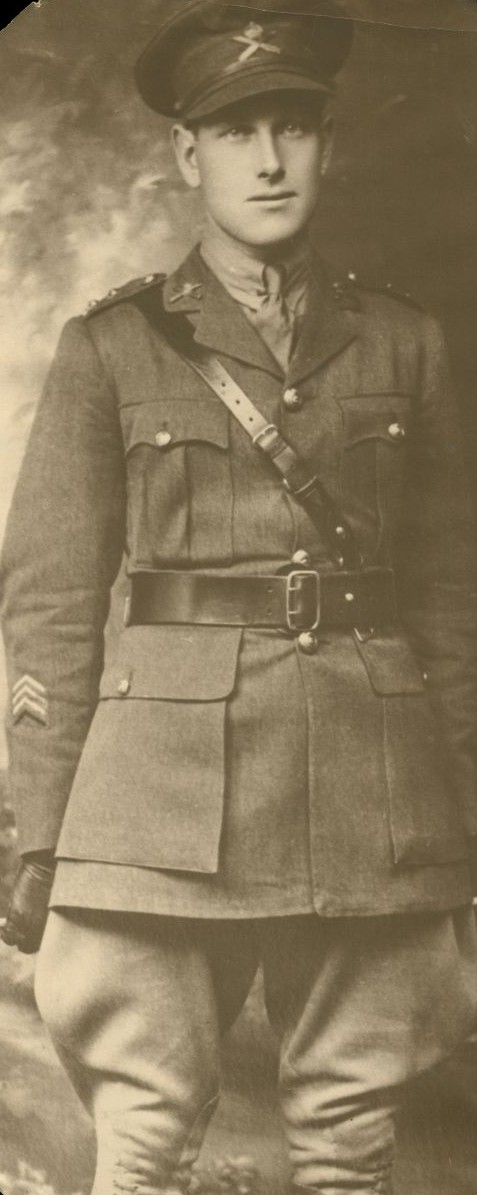
Service in the Cyclist Battalion was dangerous. Of the 1,138 men who served in the battalion, 261 were killed or wounded, a high casualty rate. The men earned the unofficial nickname "Suicide Battalions" due to the high-risk nature of their duties. Despite their vital contributions, the battalion was disbanded without formal battle honors, a historical oversight that modern intelligence units commemorate with an annual ride.
The Hundred Days Offensive in 1918, the final phase of the war when the German army was in retreat, was when the Cyclist Battalion truly "came into its own". In the more open warfare environment, their specialized training for mobile operations was highly effective. They acted as scouts, dispatch riders, and intelligence gatherers, forming a vital link between infantry and cavalry. Their ability to move swiftly and quietly allowed them to stay in constant contact with the retreating German enemy. They also engaged in direct combat operations, often operating alongside early mechanized units like armored cars and motorized machine guns. A Canadian cyclist was reportedly the first Allied soldier to cross the Rhine River into Germany after the armistice.
However, Jack was no longer with the Cyclist Battalion by this time. On his second tour of duty, he was appointed to commissioned rank in the 1st Battalion Canadian Machine Gun Corps on April 28, 1918. On October 1, 1918, just two months before the end of hostilities, he was shot by snipers at Cambrai, France, and received severe injuries to his lower back and left hand as well as injuries to his right shoulder. This injury must have occurred during the Battle of Canal du Nord, a major engagement of World War I fought by the Canadian Corps from September 27 to October 1, 1918, as part of the larger Hundred Days Offensive. The battle's objectives were to breach the German Hindenburg Line, capture the city of Cambrai, and secure Bourlon Wood. The Canadians achieved a significant victory by crossing the canal, breaking through German defenses, and taking over 7,000 prisoners, though at a high cost of over 10,000 casualties. Jack was one of those. He was sent back to England for further treatment and rehab. On January 16, 1919, in London, England he was declared unfit for any service for six months and was to be returned to hospital in Canada. He left on the "Araguaya", a Canadian hospital ship, on February 2, 1919. On June 6, 1919, in London, Ontario, he was declared fit for special duty in Canada only and was discharged June 25, 1919.
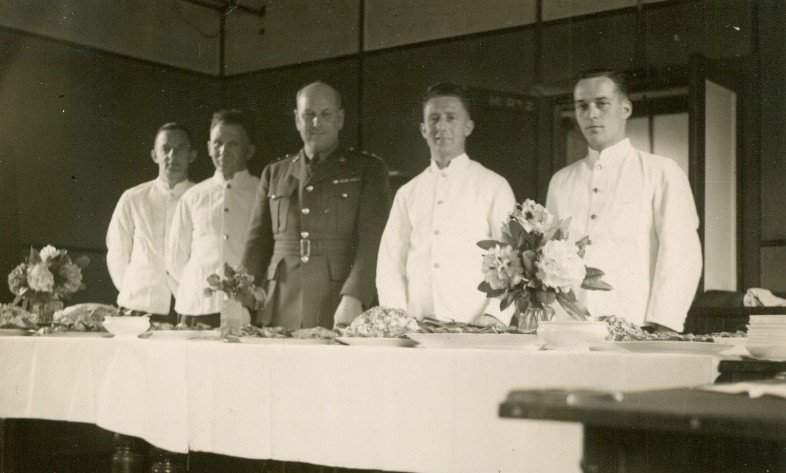
He returned to work at the bank on December 13, 1919, but retired on October 11, 1920, due to ill health. In 1926 he joined the customs and excise branch in Paris where he worked until, unbelievably, he enlisted to serve in the Second World War. On April 22, 1940, Jack was appointed to a commissioned rank in the Royal Hamilton Light Infantry. He was sent overseas to England where he served in an administrative capacity in charge of the mess.
While he was in England, he found himself on the BBC, on a radio show called “Sandy’s Canadian Half-hour”, in which Sandy would invite Canadian soldiers on the radio to talk. The BBC sent the transmission over to the CBC who put it on the air in Canada. Families were notified when their son or daughter would be on the air so they could be sure to tune in to hear their loved ones’ voices. Jack Knill was one of those soldiers because Sandy McPherson, the host of the show, was from Paris, Ontario and was one of Jack’s good friends.
Acting Lt.-Colonel John Howard Knill served on active service in Canada and the United Kingdom from April 22, 1940 to April 4, 1945, when he was struck off strength from active service in the Canadian Army and returned to reserve status at his own request. He was placed on reserve of Active Officers, General List, with the rank of Lieutenant-Colonel.
When he returned home, he married Bernadine Granton on April 18, 1945. They lived at 12 Alexander Street where they raised two daughters and a son. In 1958, he retired as customs collector to own and operate the Textile Sales Room on the Flats in Paris. He was a charter member of the Paris Lions Club which was formed in 1931 and Jack held many positions with the club and even got a 25-year perfect attendance record pin in 1956. Besides the Lions Club, he was very active in the community. In 1953 he was the chairman of the local Coronation celebration; in 1956 he was head of the town centennial; he served many years as secretary-treasurer of the Paris Board of Trade and treasurer of the Paris Arena Committee and was an associate director of the Paris Agricultural Society.
Lieutenant-Colonel Jack Howard Knill died in 1966 and is buried in Sacred Heart Cemetery in Paris.