
Warwick Street
Nursing Sister Dorothy Baldwin
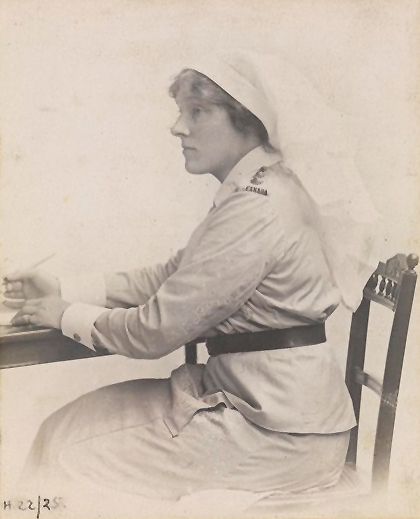
Dorothy Mary Yarwood Baldwin was born in Toronto on October 10, 1893. She was the daughter of Robert Willcocks Yarwood Baldwin and Mary Fleming Baldwin. Robert was a farmer. There were five children in the family, three girls and two boys. Dorothy’s twin sister, Lelia, died at the age of two. At some point the family moved to Warwick Street in Paris. Along with her parents, who are buried in the Paris Anglican Cemetery, Dorothy was a member of St. James Anglican Church.
Dorothy had graduated as a nurse and enlisted as a nursing sister in the Canadian Army Medical Corps in Toronto on May 2, 1917. On May 29, she embarked from Halifax, Nova Scotia, for England. Upon her arrival on June 8, 1917, she was immediately posted to the No. 16 Canadian General (Ontario Military) Hospital in Orpington, Kent. Almost two months later, Baldwin was transferred to No. 3 Canadian Stationary Hospital in Doullens, France, beginning work on July 28, 1917.
Dorothy was on duty in the officer’s ward of No. 3 Canadian Stationary Hospital, Doullens on May 29, 1918 when German aircraft dropped bombs on the hospital, completely destroying the north wing. Nursing Sister Baldwin was injured in the attack, and she died the following day. Two other Canadian nursing sisters, Agnes MacPherson and Eden Pringle, were also killed during that raid. At 23 years of age, Pringle was the youngest Canadian nurse to die during the war. Dorothy Baldwin was buried with other victims of the attack — including MacPherson and Pringle, who lie next to her — on May 31, 1918, in Bagneux British Cemetery, in France. Bishop Fallon of London, Ontario, who was visiting the area at the time of the attack, assisted in the service.
A total of more than 2,800 Nursing Sisters served in the Canadian Army Medical Corps and 2,504 of those served overseas in England, France and the Eastern Mediterranean. By the end of the First World War, approximately 45 Nursing Sisters had given their lives, though only seven dying from enemy bombing attacks on a hospital. Another German air raid on the hospital complex at Étaples, France, in May 1918 killed four nursing sisters. Overall, at least 58 Canadian nursing sisters died in service during the First World War from enemy action, disease, or drowning (such as the sinking of the hospital ship HMHS Llandovery Castle). Their sacrifice is commemorated by a memorial in the Hall of Honour in the Parliament Buildings in Ottawa, Ontario.
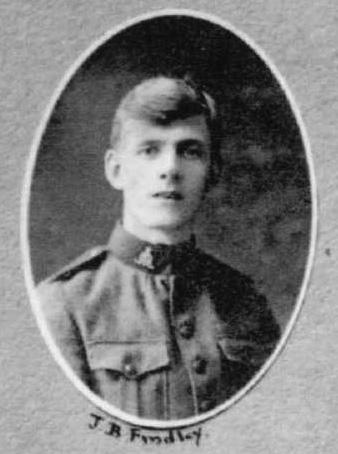
In an interesting but tragic coincidence, another casualty of the bombing of the hospital complex in Etaples was James Findlay, also from Paris. He had emigrated from Yorkshire, England and worked as a machinist in Penmans No. 1 Mill. He was wounded in November, 1916 and returned to the firing line in the 13th Battalion of the Canadian Army Medical Corps. James was 24 years of age when he was killed in the bombing raid. He is buried in the Etaples Military Cemetery.