
Corporal Luke Earle Tincknell
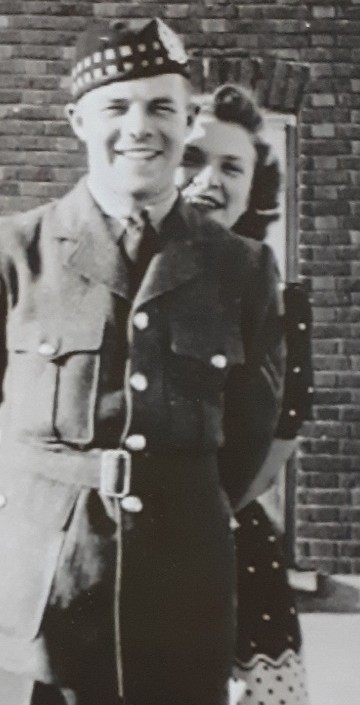
Luke Tincknell was born in Paris in 1922, the son of Charles and Anna Tincknell, who had emigrated from Somerset, England. They had three children besides Luke: a brother Ernest, and twins Vernon and Veronica. Sadly, both twins died in infancy. When the family arrived in Paris, they lived in a stone house on Main Street in Upper Town.
Luke was very athletic as a teen. He played hockey and tennis and there was a picture of him flying through the air in the pole vault competition. Later in life took up golf in which he claimed to be ambidextrous. He coached baseball and hockey when his son Jim started to play.
Luke met his future wife, Eleanor Hope Veigel, while they were both at Paris High School. Hope claims that he let the air out of her bicycle tires in order to get her to notice him. He married Hope before he went overseas in the Second World War. He was 20 and worked at the Paris post office. She was 18 and worked at the Bank of Montreal.
When war was declared, Luke enlisted for active duty. His first love was for the air force, but poor eyesight denied him that choice, so he chose the infantry. He enlisted with the Royal Canadian Artillery, Central Ontario Regiment. Luke was “dangerously wounded” while serving in Holland in 1944. A report of his injury was published on November 23, 1944, so suggesting that his injury likely occurred on October 16. This date suggests he was wounded during the Battle of the Scheldt and the initial consolidation of the Nijmegen Salient in Holland. The Battle of the Scheldt was a brutal World War II military campaign fought from October 2 to November 8, 1944. Led primarily by the First Canadian Army with Polish and British units, the objective was to open the Scheldt River to free up the vital Port of Antwerp for Allied supplies. Allied troops fought through flooded lowlands, deep mud, and dikes, making movement and heavy armor support nearly impossible. The Allies suffered 12,873 casualties, over 6,000 of whom were Canadian soldiers, during the five-week offensive.
By mid-November 1944, Canadian forces had successfully cleared the Scheldt estuary to open the port of Antwerp. Elements of the Canadian Army, including the Royal Canadian Artillery, were then ordered to hold and defend the flooded polders around the Nijmegen "island" under constant German shelling and counterattacks.
When he returned home, Luke told family members that he was the only member of his platoon to have survived a German attack. Canadian units faced intense mortar fire, waterlogged trenches, and highly dangerous reconnaissance patrols across flooded terrain. A sudden artillery strike or ambush on an isolated platoon outpost matches the timeline when Corporal Tincknell was "dangerously wounded" and his platoon was heavily hit. The account that he was not just “seriously” but “dangerously” wounded also reinforces his account.
Hope had received a report of his injury but had no other information until months later when a Salvation Army volunteer sat with Luke in hospital and transcribed his letters to Hope. (That is the reason Luke always encouraged his children to support the Salvation Kettle Drive. His daughter Mary Ann has passed that loyalty on to Luke’s granddaughter.) When Luke arrived back in Paris, he was jaundiced and had lost so much weight that Hope could hardly recognize him on the stretcher. He was sent to Sunnybrook Veterans Hospital in Toronto for rehabilitation. He had nightmares after the war and had scars over his chest and shoulder. Pieces of shrapnel had lodged in his body, and he would sometimes ask his daughter Mary Ann to pass him the test tube from his dresser drawer where he kept his collection of shrapnel fragments.
Following the war, Luke and Hope and their family lived at 35 Banfield Street. There were four children: daughters, Jane, Barbara and Mary Ann, and son Jim. Luke worked for a time in Brantford as a welder and later found work in Paris at White Mop and JD Adams where he made graders and open pit mining trucks. Later this company became WABCO where Luke was employed until his death.
Luke was a member of the Paris Legion. He and Hope were active members of St Paul’s United Church. Luke was an elder, sang tenor in the choir, and participated in plays the church performed. He joined the Paris Lawn Bowling Club and taught all his children how to fish, which became his passion, a passion he passed it on to his son Jim, who passed it on to Luke’s grandson, also Luke. After his grandfather’s experiences during the war, the peace and quiet out of doors must have been therapeutic.
Luke suffered his first heart attack when he was 49 years of age. He suffered another heart attack just after the New Year in 1974. He was taken first to the Willett Hospital, but he died in the Brantford General Hospital on January 9. The family were told that his heart had been damaged during the war. Luke was 51 years of age. Corporal Luke Tincknell is buried in the Paris Cemetery with Hope.