
West River Street
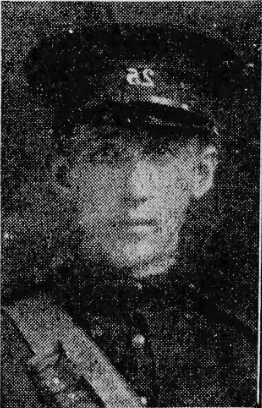
Private Mackie Ogle Stewart
Mackie Stewart was born in Oshawa, Ontario on October 28, 1896, the son of Thomas and Mary Jane Stewart. They also had three daughters and two more sons. The family moved to Paris about 1902 and lived on West River Street. The family attended the Paris Presbyterian Church. Mackie attended Paris High School and Brantford Business College. He worked at Sanderson Harold Company as a stenographer when he enlisted at 21 years of age.
Mackie enlisted with the 125th Battalion in September, 1915. He later transferred to the Depot Regiment of the Canadian Mounted Regiment at Hamilton where he was promoted to sergeant and clerk of the orderly department. He went overseas in April, 1916. He reverted to the rank of Private and transferred to the 102nd British Columbia Infantry, reaching France in August, 1916. The 102nd was on the Western Front and began its involvement in the Battle of the Somme, a major offensive that lasted from July to November of that year. The battalion served in the trenches and was reinforced with drafts of men to fill gaps left by casualties.
The Battle of the Somme came to typify the futility of trench warfare in World War I. The battle began on July 1, 1916 with a massive attack by hundreds of thousands of British and French troops, who would be mowed down by German machine guns as soon as they rose from their trenches. More than 57,000 British and Commonwealth troops, including the Newfoundland Regiment, would be killed in one day, the highest single day losses in the history of the British Army. Of the 790 Newfoundlanders who went over the top, 710 were either killed or wounded.
The 4th Canadian Division arrived on the Somme in mid-October to take over from their exhausted fellow Canadians who had been fighting there. They faced a battlefield that had turned to mud and a determined German defence that continued to take a murderous toll on Allied attacks. Despite these great challenges, the Canadians finally captured the shattered remains of Regina Trench on November 11. A week later, in the final attack of the Battle of the Somme, the Canadians took Desire Trench. There were no further advances as the winter weather came and the offensive staggered to a halt. The ‘Big Push' had resulted in the Allied lines being moved forward only some ten kilometres. The enormity of the lives wasted for such a minimal gain is difficult to comprehend.
In November, 1917, the 102nd Battalion found itself heavily involved in brutal, futile fighting at the Battle of Passchendaele, in Flanders, Belgium. They endured intense German shelling and took heavy casualties as they secured the ridge, before being withdrawn to the Vimy-Lens area by mid-November. After the success of the Battle of Vimy Ridge, the Battle of Passchendaele was a disaster. This brutal WWI campaign, from July to November, 1917 is known for horrific mud, massive casualties (over 260,000 British/Commonwealth soldiers, 220,000 German), and slow, costly gains, with Canadian troops eventually capturing the ridge at a huge price, only for much of the ground to be lost to Germany shortly after. It became a symbol of the war's futility, with soldiers drowning in mud-filled shell craters, and cemented Canada's national identity through the Corps' immense sacrifice.
Private Mackie Ogle Stewart was killed in action on November 1, 1917. He died at No. 3 Canadian Casualty Clearing Station. He was 21 years old. Mackie is buried in Lijssentheok Military Cemetery, 12 kilometers west of Ypres.