
Lance Corporal Robert Alexander Stevenson
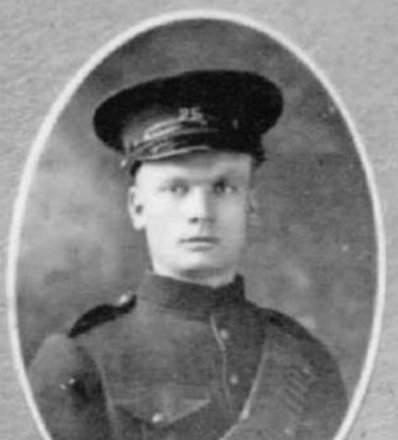
Robert Alexander Stevenson was born in Brantford on February 18, 1895. He enlisted on August 31, 1915, with the 84th Overseas Battalion C.E.F. He lived in the Paris Junction at the time and was a cabinet maker. He was certified and passed his medical on September 6, 1915 at Niagara Camp. He sailed with his unit from Halifax on the S.S. Empress of Britain on June 18, 1916, arriving in England on the 28th. Alexander was transferred to the 7th Battalion on July 3, 1916, and on August 8 embarked for France from Bramshott.
The battalion was holding sectors of the area of Ypres when he received a gunshot wound to the head. He was admitted to No. 3 General Hospital in Boulogne on November 21. He was transferred on the 24th to Northern General Hospital, in Beckette Park, Leeds, England, then on December 20 to a Canadian military convalescent hospital in Woodcote Park, Epson. Alexander was discharged on January 1, 1917. He remained in England until April 8, 1917 when he was sent back to France.
On January 14, 1918 Alexander was appointed Lance Corporal with the 75th Battalion. In August, the 75th Canadian Infantry Battalion (Mississauga) was heavily engaged in the Battle of Amiens in France, the start of Canada’s historic offensive known as the Last Hundred Days. On August 8, the 75th Battalion had successfully spearheaded the brutal assault to capture the heavily fortified village of Le Quesnel. By August 10, as part of the 11th Infantry Brigade (4th Canadian Division), they were pressing further east into German-held territory alongside sister battalions, the 54th and 102nd. While other sections of the 4th Division pushed to capture towns like Maucourt and Chilly, the 75th Battalion encountered fierce resistance. Hidden German machine-gun nests and artillery batteries—rapidly deployed by the enemy to plug the holes in their line—stalled the advance. Due to intense open-field fighting and counter-battery shellfire, the 75th Battalion suffered significant casualties during this window before being relieved in the front line shortly thereafter.
Alexander was admitted to No. 9 General Hospital in Rouen with a gunshot wound to his back in the sacrum area. Then on October 17, 1918 he was transferred to Northamptonshire War Hospital on the 15th. Ironically, he was sent to the same convalescent hospital he was at in Epson and discharged on November 6. On January 12, 1919 he was transferred to No. 1 District Depot, London, Ontario. On the 26th he was posted to the Casualty Company and granted furlough until February 10. Alexander was finally discharged on February 13,1919. His discharge medical showed that he had no disability because of his two injuries.
By 1921 Alex was living at home with his parents and nine siblings. He worked as a section man for a railway. In 1930, Robert Alexander Stevenson, now a mechanic and 35 years old, married Mary Holmes aged 24. Both were still residing in Paris at the time. The wedding article in the Expositor stated that they were going to live in Brantford. But according to the 1931 census they were both living in Sarnia where he maintained signals for the steam railway. They moved to Fort Erie in 1932 and Alexander continued his career as a signalman until he retired. Lance Corporal Alexander Stevenson died in 1969 and was survived by three sons, three brothers, all of Paris, and two sisters from Paris and one from Hamilton. He is buried with his wife at Saint Paul’s Anglican Cemetery in Fort Erie.