
Walnut Street
Private William George Chapman Stevens
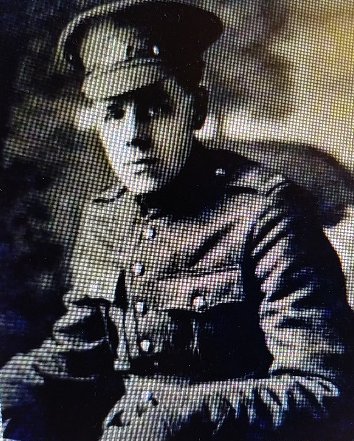
William was born in Toronto on August 9, 1899. He was the only child of the late W.G. Stevens and Emma J.C. Stevens. He lived in Toronto until the death of his mother when he was adopted by his aunt, Helen Sewell, who lived on Walnut Street in Paris. He moved to Paris in 1914 and attended school in Paris. They attended the Paris Baptist Church. While still a student, aged 16, William enlisted with the 125th Battalion in Paris.
He was a member of the 9th Platoon that embarked aboard the S.S Scandinavia on February 12, 1916. The 9th and 10th Platoons were the first contingent of soldiers from Paris, nearly 100 men, to go overseas. He was drafted into the 60th Battalion with which he went to France. He was wounded in June, 1917, after the Battle of Vimy Ridge, and after his recovery he was drafted to the 87th Battalion.
In September, 1918, the 87th Canadian Battalion (Canadian Grenadier Guards) was involved in fierce fighting as part of the Battle of the Drocourt-Quéant Line, where the Canadian Corps successfully broke a key German defensive position. The 87th Battalion was part of the 4th Canadian Division, which was tasked with clearing and capturing positions related to the Canal du Nord, particularly around Bourlon Wood, after the initial line had been breached. The Canadian Corps launched its main assault at daybreak on September 2nd, with the 1st and 4th Divisions spearheading the attack on the Drocourt-Quéant Line itself. The battle was relentless, and the Canadians faced strong German resistance, including heavy machine-gun fire. The 87th Battalion incurred significant casualties during this phase of the offensive. Despite the heavy cost, the Canadian forces successfully overran the German positions, capturing the villages of Dury, Cagincourt, and Villez-sur-Cagnicourt, and forcing the German army to retreat across the Canal du Nord by nightfall.
The successful breakthrough on this day was a crucial victory in the Hundred Days Offensive and a major factor in the eventual collapse of the Hindenburg Line and the German war effort. Private William Stevens was severely wounded by enemy shellfire near the jumping off trench at the beginning of the assault. He was immediately evacuated from the line, but he died before reaching the Field Ambulance. William is buried in the Vis-en-Artois British Cemetery in Pas de Calais, France. The First World War ended about two months later.