Private Alfred Henry Richardson
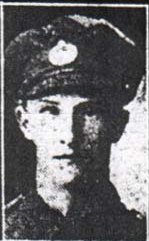
Alfred Richardson was born in Paris on June 17, 1899. He was the son of Mr. and Mrs. George Richardson. He also had two brothers. The family attended the Paris Presbyterian Church. Alfred was employed as a mill hand at Penmans No. 1 mill, where he was on the Penmans honour roll. Alfred enlisted in 1916 at 17 years of age in Brantford with the 25th Brant Dragoons, then transferred to the Canadian Mounted Rifles. He was overseas with the 10th Calgary Battalion.
Alfred was present at the Battle of Vimy Ridge in April, 1917, where he was wounded, though he was proud to say he was the fourth man in his battalion to go “over the top”, to leave the trench and advance on the enemy. Over four days of bloody fighting, the Canadians had overrun Vimy Ridge at the cost of more than 10,600 killed and wounded. It was the largest territorial advance up to that point in the war. The battle has since become an important symbol for Canada, the place where Canadians from across the country delivered an unprecedented victory, all four divisions of the Canadian Corps fighting together for the first time in the war. The victory at Vimy was a defining event for Canada, considered by many contemporaries and later scholars to be a significant event in Canada’s progress to full independence from Britain.
Alfred also served through the Battle at Hill 70 in August, 1917, which also was important as a major Canadian victory in 1917, showcasing new tactics under General Arthur Currie to draw German reserves from Passchendaele, inflict heavy German casualties (20,000-30,000) while suffering fewer themselves (around 9,000). Those tactics established Canada's reputation for effective offensive operations, leading to greater international respect. It was a crucial strategic success, securing high ground overlooking Lens and demonstrating Canadian tactical brilliance, despite being a brutal fight involving new tactics like oil drums in trenches. However, during the Battle for Hill 70, the Germans used mustard gas against Canadian forces, marking the first significant deployment of this blistering agent against them and causing numerous casualties. It was the first time Canadians encountered mustard gas, a weapon that blistered skin and caused severe respiratory issues. The gas was fired in shells, saturating the Canadian front and contributing to the heavy casualties, despite the use of gas masks.
The effects of mustard gas led to the end of Alfred’s military service. He was admitted to a military hospital where he was diagnosed with cerebritis, an early, localized brain inflammation. Symptoms include fever, headache, confusion, seizures, or neurological impairment. He was given an honorable discharge and returned to Canada. He continued to receive treatment in Toronto but died on April 12, 1918. His mother said, “I am so thankful that my boy was spared to come home to me.” Alfred was not yet 19 years old. He is buried in Prospect Cemetery in Toronto.