
Private Harry Mattingley
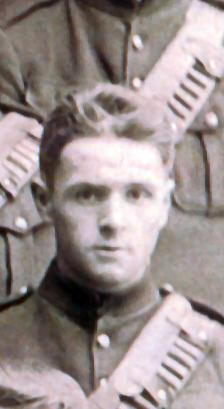
Harry Mattingley was born in Witley, Surrey, England on January 31, 1892. He was the son of Constance Mattingley. Harry had six other brothers who also served in the First World War. Harry immigrated to Canada on his own in March, 1913 when he listed his trade as a carpenter. However, when he enlisted with the 24th Battalion, Victoria Rifles of Canada, in Niagara on August 31, 1915, he identified himself as a farmer. He named his mother in England as his next of kin, but also included a handwritten note to notify Mrs. Frank Jenner at Box 314 Paris Station which certainly suggests that he was working as a farmer at the Jenner farm near Paris.
Harry volunteered and initially joined the 84th Battalion, an infantry unit raised in the Brantford region. The 24th Battalion was a Montreal battalion but because it suffered heavy casualties on the Western Front, the battalion required a constant influx of replacement troops throughout the war, drawing men from across Canada, including Ontario.
Harry went overseas with the 24th Battalion. In October, 1916 , the 24th Battalion (Victoria Rifles of Canada) was entrenched in the brutal, mud-soaked aftermath of the Battle of the Ancre Heights, a major phase of the larger Battle of the Somme in France. Throughout the first half of October, the 24th Battalion was repeatedly thrown into horrific, bloody assaults to capture a heavily fortified German defensive position known as Regina Trench. Just days prior, on October 1 and October 8, the battalion suffered staggering casualties attempting to storm this system amid driving autumn rains, thick mud, and unrelenting enemy artillery.
By October 14, the relentless offensive push had temporarily paused due to the exhaustion of the troops and the sheer devastation of the terrain. On this exact day, the remaining men of the 24th Battalion were holding highly unstable, shell-torn positions. They were enduring constant German shellfire, sub-zero nightly temperatures, and knee-deep mud, while planning for a relief rotation out of the line to rear billets like Mailly-Maillet.
On October 14, Harry Mattingley died of his wounds. He had been severely wounded in the skull by shrapnel during the battalion's intense fighting earlier in the month, most likely during the October 1st assault on Regina Trench.
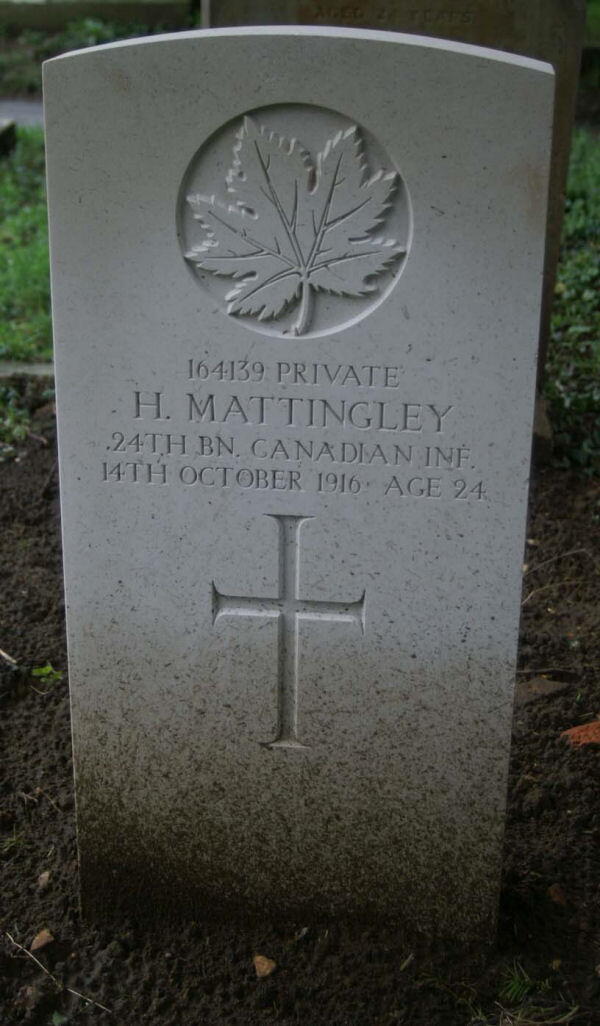
He was evacuated via a medical pipeline that took him to a hospital ship and eventually back to England. On October 14, while his battalion mates were still trapped in the mud of the Somme, Harry succumbed to his head wounds at the Duchess of Connaught Canadian Red Cross Hospital in Taplow, Buckinghamshire. Private Harry Mattingley is buried in Witley All Saints Churchyard in the church where he was raised. He was 24 years of age.