
West River Street
Sergeant-Major James Robert Herriot
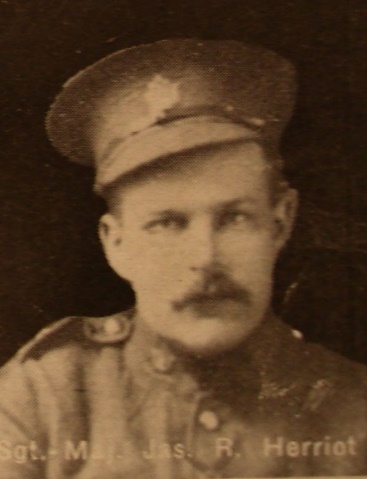
James Herriot was born on August 19, 1880 In Galt, Ontario. He was the son of Mr. and Mrs. David Herriot. He had one sister and three brothers. James was an electrician, and before moving to Paris, he had been employed by the Hydro-Electric Power Company in Hamilton for two years. Since 1910, he lived on West River Street and worked for the Paris Hydro-Electric Commission. He was a member of St. Paul’s Methodist (now United) Church and also of the Oakville Lodge of the International Order of Odd Fellows. James married Maud Godfrey of Galt, and they had two children, a boy and a girl.
James enlisted with the 125th Battalion in September, 1915 and went overseas the following year. He was a Company Sergeant-Major in the battalion and a member of the 9th Platoon that embarked aboard the S.S Scandinavia on February 12, 1916. The 9th and 10th Platoons were the first contingent of soldiers from Paris, nearly 100 men, to go overseas. He wanted to fight in Europe, so upon arrival in England, he reverted to a reduced rank and was transferred to the 54th Battalion and went to France. He was reported wounded on August 9, 1918 and had only been back on the firing line for 10 days when he was killed in action on September 30. While the battalion advanced on the enemy position near the village of Tilloy-lez-Cambrai, he was killed instantly by enemy shell fire.
On September 30, 1918, the village was the site of intense fighting during the First World War, with the village being captured by the Princess Patricia's Canadian Light Infantry (part of the Canadian Corps). This action was part of the wider Battle of the Canal du Nord and the push toward Cambrai. Troops renewed their offensive on September 30 to secure gains made the previous day and prevent German counterattacks. It was a harsh day for the exhausted Canadian Corps, which had already suffered over 2,000 casualties the day before. Troops advanced despite disorganized artillery support and strong German defenses. The 4th Canadian Division captured the village of Tilloy, one of the few successes of the day, despite being dangerously exposed to enemy fire. In the afternoon, the decision was made to stop the advance and consolidate the positions that had been won, especially the high ground east of Tilloy.
Sergeant James Herriot is buried in the Cantimpre Canadian Cemetery near Cambrai. He was 39 years old. The war would be over in six weeks.