
Private Alfred Hanlon
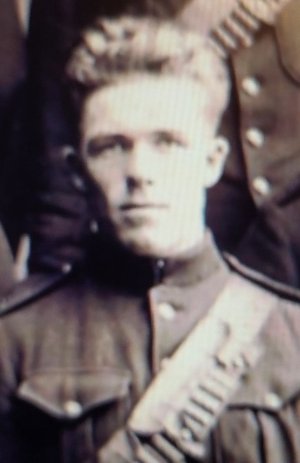
Alf Hanlon was born in Omagh, County Tyrone, Ireland on November 18, 1892. He had immigrated to Paris and was working as a laborer when he enlisted. He lived on Queen Street. Before the war, Alf served with the 25th Brant Dragoons. Alf enlisted with the 84th Battalion, a World War I infantry unit authorized in July 1915 and recruited in Toronto, Ontario. The battalion sailed for England in June 1916. Upon arrival, the personnel were absorbed by other battalions. Alf was transferred to the 1st Canadian Infantry Battalion on March 9, 1916 and went to France.
On September 4 1916, he received a gunshot wound to his right thigh. On September 8, he was admitted to the Lord Derby War Hospital in Warrington, a massive 2,000-bed military medical facility established in 1915 at the former Winwick Rectory estate/Lancashire County Asylum in Warrington, Lancashire. It was one of the largest medical hubs in the UK during World War I, treating approximately 56,000 casualties and pioneering treatments for severe "shell shock" before closing in 1920.
While receiving treatment there, he was transferred on September 21 to the Canadian Casualty Assembly Centre (CCAC). It was an administrative and medical clearing unit responsible for evaluating wounded or recovering soldiers to determine if they were fit to return to the front or required further medical treatment. He was then transferred to the Canadian Convalescent Hospital in Bromley on October 3, 1916. While in Bromley, he was examined by a medical board who deemed that he would be fit for duty after six weeks of exercise. However, on January 23, 1917, he was transferred to the 4th Canadian Reserve Battalion. He was transferred to the 4th Battalion on April 21, 1917 and then the 1st Battalion on August 26, 1917. These transfers seem to have been administrative procedures leading to Alf’s discharge.
He was demobilized on April 25, 1919. He sailed to Canada aboard the S.S. Belgic and arrived in Halifax on April 23, 1919. Private Alfred Hanlon received his final discharge in Hamilton on April 25, 1919.
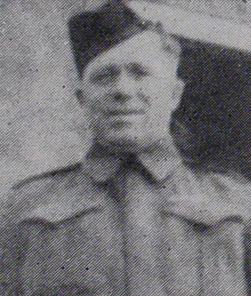
Alf married in 1923, and he and his wife were living at 19 Washington Street. They had two sons, but one of them died of whooping cough in 1929. During the Second World War, the Dufferin and Haldimand Rifles of Canada mobilized for active service on May 24, 1940 in a home defence role. The Ministry of National Defense had established a force to be known as the Veteran’s Home Guard for the adequate protection of military property on the home front. The Home Guard would free younger men for overseas duty by replacing the Canadian Provost Corps (the military police of the Canadian Army) guarding facilities such as the 40 internment and pow camps operated across Canada during WW2. Alfred Hanlon served in the Home Guard, so he was one of the few veterans from Paris who served in both World Wars.
Alfred Hanlon died on January 28, 1980 and is buried in the Paris Cemetery.