
181 West River Street
Privates Arthur and Alfred Gibbons
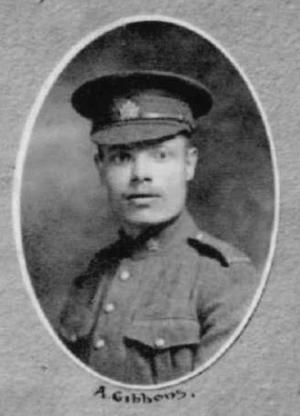
Arthur Gibbons was born on April 19, 1891 in Skendleby, Lincolnshire, England. He immigrated to Paris in 1911, and he was employed at Penmans No. 1 Mill, where he earned a place on the honour roll. Arthur had a twin brother, Alfred, who served with the 125th Battalion. The family were members of Sacred Heart Catholic Church in Paris. Arthur was married, and his wife, Mary, as well as his child and mother, sailed in November, 1916, to England where they were to meet up with Arthur. That meeting never occurred.
Arthur had enlisted, at 24 years of age, with the 58th Battalion and later was drafted into the 38th Battalion, leaving for England in 1915. In was then transferred to the 20th Battalion and went to France in January, 1916 in a machine gun section.
On the morning of September 15, 1916, the 2nd Canadian Division launched an attack on the German-held village of Courcelette and the nearby sugar factory, which had been turned into a strongpoint. The assault began at 6:20 a.m., following an intense artillery barrage. The 20th (Central Ontario) and 21st (Eastern Ontario) Battalions of the 4th Canadian Infantry Brigade advanced together, with the 21st Battalion capturing the heavily fortified ruins of the sugar factory after fierce, close-quarters fighting. The 20th Battalion, with which Arthur served, secured the adjacent "Candy Trench" system.
A single British tank, one of the first ever used in combat, supported the attack. It advanced toward the factory, spreading panic among the German defenders and helping to neutralize a machine-gun post, though the infantry had largely captured the position by the time it arrived. The unexpected collapse of the German position at the sugar factory was a significant tactical success, resulting in the capture of around 125 German prisoners and contributing to the eventual capture of Courcelette village itself later that day by the 22nd and 25th Battalions. The 20th Battalion consolidated its position and repelled German counterattacks over the next day before being relieved. The overall Battle of Flers-Courcelette was considered a tactical victory for the Allies, though it was part of the broader, and extremely costly, Battle of the Somme.
Arthur Gibbons was killed in action during the attack on the sugar factory. The Battle of Courcelette, which included the attack and capture of a German-held sugar factory in September 1916 during the Battle of the Somme, resulted in heavy Canadian casualties. The Battle of the Somme as a whole cost the Canadian Corps 24,029 casualties (killed, wounded, or missing) by the time the Somme offensive ended in November. Arthur is remembered at the Vimy Memorial in Pas de Calais, France.
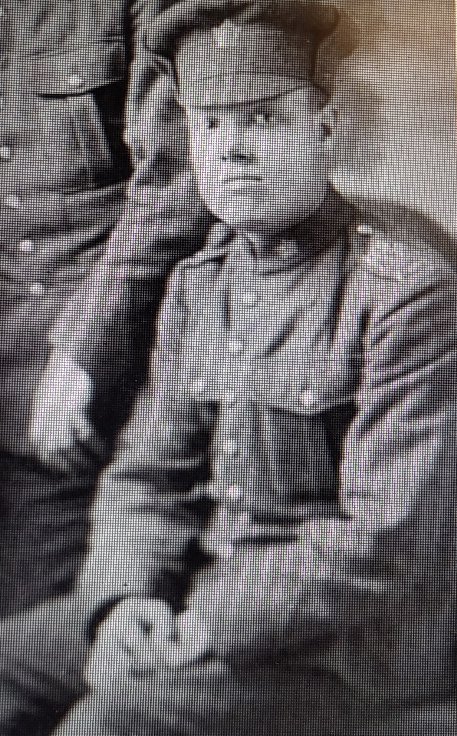
Arthur’s twin brother, Alfred Gibbons, was employed as a hosiery boarder at Penmans Mill #1. Like his brother, Alfred enlisted at 24 years of age, but unlike Arthur, he was single when he enlisted and he enlisted with the 125th Battalion in Paris. Alfred was a member of the 9th Platoon that embarked aboard the S.S Scandinavia on February 12, 1916. The 9th and 10th Platoons were the first contingent of soldiers from Paris, nearly 100 men, to go overseas. He would have been transferred to another battalion after arriving in England, but we know nothing more of his military service during the war except that he survived it.
After the war, Alfred returned to Paris and continued to work at Penmans. He was a lifelong member of Paris Branch 29 of the Royal Canadian Legion. He married Georgina May O’Connor and they had three sons and two daughters. The family lived at 181 Grand River Street. One of those sons, Harold Gibbons, served with the Merchant Marines and later the Royal Canadian Air Force during the Second World War and rose to the rank of Flight Sergeant. Another son, also Alfred, served during the Second World War and was killed in action at Dieppe. Alfred Gibbons Sr is buried at the Sacred Heart Cemetery in Paris.