
Mitchell Avenue
Private James Crawford
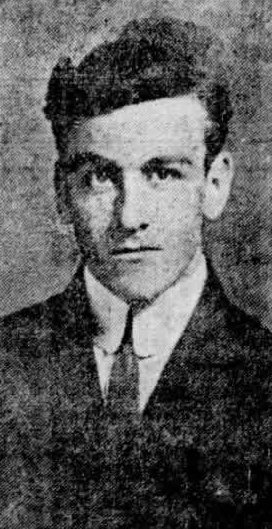
James Crawford was born on March 23, 1895 in Paris. His parents were James Crawford and Mary Jane Ware of Paris Junction. James enlisted in Windsor on June 13, 1917, but his address at the time was on Mitchell Avenue in Detroit. He listed his trade as toolmaker, suggesting that he was working in Michigan in that trade. It is not clear why he waited until that time to enlist, but the United States were about to join in the war in April, 1917 which might have been his spur to return to Canada.
James originally enlisted with the Divisional Cyclist Company who were trained in Canada for fast reconnaissance, message dispatch, and mobile screening. He arrived in England in late 1917 or early 1918 and was absorbed into the Reserve Battalion which was created to replace soldiers who had been injured or killed in front line battalions. He was taken on strength by the 10th Battalion in late May or early June. Because he arrived in early summer, his brief three months with the 10th Battalion placed him squarely into the final, defining chapters of the war.
The Battle of Amiens, fought from August 8 to 11, 1918, was a massive Allied surprise attack in northern France that launched the Hundred Days Offensive. Spearheaded by British, Australian, Canadian, and French troops using advanced combined-arms tactics, the Allies advanced 13 kilometers on the first day alone, shattering German morale. Coordinated use of over 400 tanks, creeping artillery barrages, tactical air support, and swift infantry movement won the battle. German General Erich Ludendorff famously called August 8th "the black day of the German Army" because entire units lost morale and surrendered. The massive success broke through static trench systems and restored mobile warfare. It marked the true beginning of the end for Germany in World War I, leading directly to the armistice on November 11, 1918.
However, the war was not over. The storming of the Drocourt-Quéant Line, on September 2, 1918 was the next major offensive operation, led by the Canadian Corps, during the Hundred Days Offensive of the First World War. These victories forced the German army back and helped bring about the end of the conflict. In the face of desperate resistance, the Canadian Corps under Sir Arthur Currie broke through a heavily fortified branch of the Hindenburg Line consisting of deep trenches, concrete bunkers, and thick barbed wire, forcing a further German retreat toward the Canal du Nord, the site of the ultimate German defeat.
However, James Crawford survived the brutal Battle of Amiens in early August, only to fall weeks later on September 2 at the Drocourt-Quéant Line.
James was serving with the 10th Battalion on September 2, 1918 when he died of his wounds. “While advancing with his Battalion west of Villiers-les-Cagnicourt, he was hit in the head by shrapnel from an enemy shell. His wounds were dressed by a comrade and he was removed to No. 3 Canadian Field Ambulance where he died later in the day.”
James is buried in Faubourg-D’Amiens Cemetery in Arras. He was 23 years of age. The First World War would be over in ten weeks.