
Dumfries Street
Sergeant George Arthur Caile
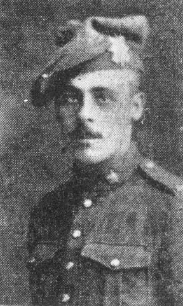
George Caile, the son of Robert and Charlotte Caile, was born in Battersea, London, England on August 10, 1896 and immigrated to Canada in 1907. George had six younger sisters. The family moved first to Kingston, Ontario, then in 1909 to a home on Dumfries Street in Paris. He was Assistant Scoutmaster while he lived in Paris. The family attended St. James Anglican Church.
When the First World War broke out, George first enlisted for home service and was stationed at Fort Henry in Kingston. Later, he enlisted with the 80th Battalion at Kingston and went overseas in May, 1915. On arrival in England, he was transferred to the 73rd Royal Highlanders and served in the trenches for some time. At the time of his death, he was in the machine gun section.
George died of his wounds on October 31, 1916 at No.13 Field Ambulance. While working behind a parados, or mound of dirt that protected the trench, when he was hit in the stomach by a bullet from the rifle of an enemy sniper. He was evacuated to the Ambulance and died shortly after.
George died during the Battle of the Somme, which came to typify the futility of trench warfare in World War I. The battle began on July 1, 1916 with a massive attack by hundreds of thousands of British and French troops, who would be mowed down by German machine guns as soon as they rose from their trenches. More than 57,000 British and Commonwealth troops, including the Newfoundland Regiment, would be killed in one day, the highest single day losses in the history of the British Army. Of the 790 Newfoundlanders who went over the top, 710 were either killed or wounded.
The 4th Canadian Division arrived on the Somme in mid-October to take over from their exhausted fellow Canadians who had been fighting there. They faced a battlefield that had turned to mud and a determined German defence that continued to take a murderous toll on Allied attacks. Despite these great challenges, the Canadians finally captured the shattered remains of Regina Trench on November 11. A week later, in the final attack of the Battle of the Somme, the Canadians took Desire Trench. There were no further advances as the winter weather came and the offensive staggered to a halt. The ‘Big Push' had resulted in the Allied lines being moved forward only some ten kilometres. The enormity of the lives wasted for such a minimal gain is difficult to comprehend.
George is buried in the Poizieres British Cemetery, Somme, France.