
25 Church Street
Private Walter Bradbury
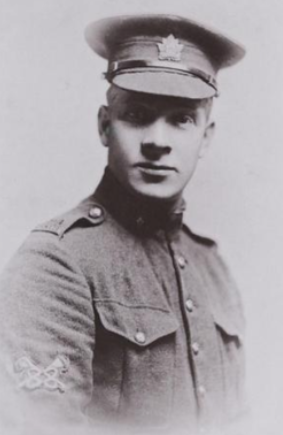
Walter Bradbury was born in Manchester, England on January 7, 1885. He immigrated to Canada in 1902 and lived in Port Dover, Simcoe, and St. Thomas before moving to Paris. His mother, Ruth Adams, remained in Port Dover. In 1905 he married Lillian Franks of Simcoe, and they had three children. The family lived at 25 Church Street. He also had two sisters in Brantford. He was a member of St. James Anglican Church.
Walter, also known as Curly, worked at Penmans No. 1 Mill. He was also the pianist at the Gem Theatre when he enlisted in November, 1914, at 29 years of age with the 4th Canadian Mounted Rifles (C.M.R). He went overseas in June, 1915. He served with the C.M.R. until March, 1917 when he was transferred to the Machine Gun Corps. The Canadian Machine Gun Corps (CMGC) played a crucial role in the Battle of Amiens from August to November, 1918, spearheading the massive Allied offensive that began the Hundred Days to final victory. The offensive surprised the Germans with a swift, infantry-tank assault that smashed through defenses. Though at a heavy cost, it marked a devastating blow to German morale, famously dubbed "the black day of the German Army". The CMGC helped execute a surprise attack without heavy preliminary bombardment, using tanks and infantry to rapidly advance. Canadian troops, supported by machine gunners, faced heavy fire from German machine gun nests, quickly overcoming them to achieve significant breakthroughs. The success of the Canadian Corps at Amiens shattered German morale and began the final Allied push to victory in World War I, leading to "Canada's Hundred Days". Despite the success, that advance was costly, with over 1,000 Canadian soldiers killed and thousands wounded, highlighting the brutal nature of the fighting.
On August 8, 1918, while asleep, Walter was seriously wounded in the leg, stomach and shoulder by an enemy shell. His wounds were dressed and he was carried to an advance dressing station and from there to No. 5 Casualty Clearing Station where he died of his wounds. He is buried in the Crouy British Cemetery in Crouy-sur-Somme, France.