
Private James Blaney
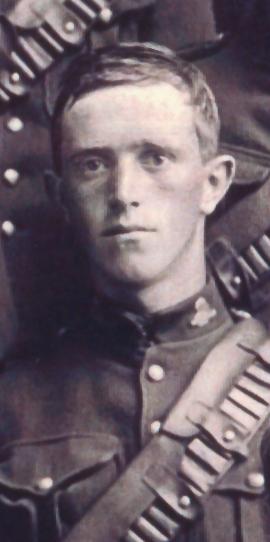
James Blaney was born in Omagh, County Tyrone, Ireland on November 14, 1891. He immigrated to Paris with his sisters, Maggie and Minnie Blaney, in 1912. His father, as well as two sisters and two brothers, remained in Ireland. James was a member of St. James Anglican Church and the Loyal Orange Lodge. He worked in Paris as a laborer.
James enlisted at 24 years of age with the 84th Battalion in 1915, with which he went overseas. He was later transferred to the 14th Battalion and served in France for two years. In September 1918, the 14th Canadian Battalion (Royal Montreal Regiment) played a crucial role in the Canadian Corps' August-September offensive, particularly during the capture of the formidable Drocourt-Quéant Line and the subsequent advance towards the Canal du Nord, where they attacked Cagnicourt on September 2nd, overcoming strong defenses and capturing the village by attacking from the rear after breaking the main line, an action marked by extreme bravery.
The 14th Battalion was part of the massive Canadian effort to break this heavily fortified German defensive line, a key objective in the Battle of Arras. After breaching the main line, the battalion attacked Cagnicourt, a strategic village, by assaulting it from the rear, ending its four-year occupation. Lieutenant George Burdon McKean led scouts, rallied troops, and captured over 100 retreating enemy soldiers, preventing heavy casualties, earning him the Victoria Cross for his actions near Cagnicourt on September 1st/2nd.
The fighting around Cagnicourt was central to the larger Battle of the Canal du Nord, a complex operation where the Canadians advanced significantly, securing the west bank of the canal. The capture of Cagnicourt and the surrounding area was a major tactical success, showcasing the Canadians' ability to overcome formidable defenses through bold tactics and leadership. This victory helped pave the way for the broader Allied offensive against the Hindenburg Line, marking a decisive phase in the war. In essence, September 1918 saw the 14th Battalion heavily engaged in some of the most decisive and difficult fighting of the war, demonstrating exceptional courage and contributing significantly to the collapse of German defenses.
James was killed in action on September 2, 1918 in the vicinity of Cagnicourt. He is buried in the Upton Wood Cemetery in Hendecourt-les-Cagnicourt.