
1 Acre Street
Driver Percy Walter Blackman
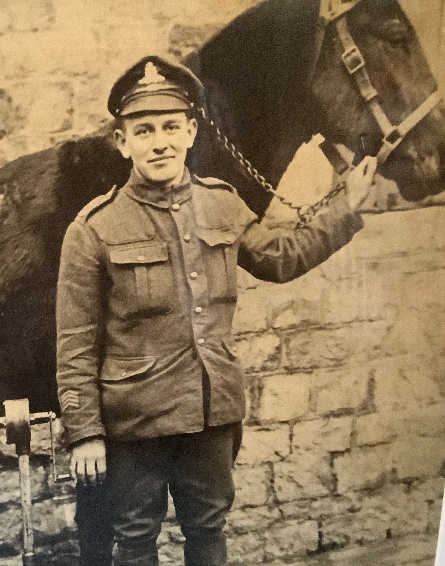
Percy Blackman was born in London, England on February 20, 1899. When he enlisted in the First World War on July 15, 1915, he told the recruitment officer he was born in 1896, so he began his military career when he was 16 years old. He trained at Woolwich to prepare him for work with horses. Perhaps he already had some knowledge, maybe as a delivery boy in London, but he would have had rigorous training, first with full-sized wooden horses and then with real ones. He clearly developed an accord with horses if he did not have it already.
Percy served as a Driver in the British army’s Ammunition Column 3rd Cavalry Division. Serving in France and Belgium, he rode and guided teams of horses hauling wagons of ammunition that kept British frontline weapons firing. Operating under the Royal Horse Artillery (RHA), these units faced a massive, unrelenting supply-chain challenge. They were tasked with moving heavy artillery shells and small-arms ammunition from rear supply dumps right to the front line. The massive Divisional Ammunition Columns (DAC) that hauled the bulk of the ammunition forward from the rear supply dumps were predominantly manned and reinforced by the Royal Field Artillery (RFA). Because men and draft horses were constantly shifted around to replace casualties, an RFA Driver like Percy would easily find himself assigned to haul ammunition for a cavalry division's supply pipeline.
Percy’s rank as a Driver in a WWI Ammunition Column was a highly specialized and brutal job. Drivers did not sit on the wagon seats. Instead, they rode the actual horses pulling the heavy General Service (GS) ammunition wagons or limbers. A standard ammunition wagon required a team of six horses, moving in pairs (the "lead", "centre", and "wheel" pairs). Three Drivers rode on the left-hand (near-side) horse of each pair, controlling both their own horse and the hand-horse beside them. Percy would have been responsible for navigating these massive animal teams through pitch-black nights, shell-cratered battlefields, and deep mud to deliver artillery rounds to the forward lines. Drivers had to be expert horsemen, as a panicked horse team in a shell-hole could flip an entire wagon of live explosives.
Percy arrived at the front lines on September 1, 1915. The 3rd Cavalry took part in the Battle of Loos, from September 26 to 28, 1915. This was his first experience at the front line. The 3rd Cavalry were initially held in reserve, but when the attack stalled and, Percy’s division suffered heavy casualties, they dismounted and went into the trenches on foot. They were rushed forward to Hill 70 near Loos-en-Gohelle in France to fill critical gaps in the line. While Percy didn't fight in the trenches, he still moved forward into highly dangerous areas. The artillery batteries of the 3rd Cavalry Division (the IV Brigade RHA) did not dismount. They stayed with their guns to fire massive barrages supporting the attack. As a driver, Percy's job was to harness his horse team under cover of darkness and haul heavy ammunition wagons from the rear dumps right up to the forward gun positions. This meant driving heavy explosives through choked roads, pitch-black night, and heavy German retaliatory shellfire aimed specifically at supply routes.
Following the heavy losses at Loos, the division did not participate in any major named offensives for the remainder of 1915 or throughout 1916. Instead, they were routinely sent into the frontline trenches in the French/Belgian sectors as dismounted units to give regular infantry divisions a rest. But even when the cavalry troopers weren't actively charging, the artillery batteries still fired daily. For a Driver like Percy, this period meant constant, grueling night journeys hauling ammunition through winter mud and rain to keep forward supply dumps stocked.
The next major battle for the 3rd Cavalry Division was the battle of Arras in April, 1917. Before the attack even began on April 9, 1917, Percy and his horse team would have worked to the point of absolute collapse. To break the German lines, the British fired roughly 2.7 million artillery shells in the week leading up to the assault. Light railways and motor lorries couldn't get through the shattered landscape close to the guns. It fell entirely upon Drivers like Percy to bridge the gap. He would have spent weeks making endless, heavy night-runs to haul tons of 13-pounder and 18-pounder shells into hidden forward ammunition dumps under the cover of darkness. Because the German Army knew the British were using massive cavalry and horse transport numbers at Arras, German long-range guns constantly targeted the British rear "horse lines" and supply columns. Percy’s days between supply runs would have been spent treating wounded horses, dealing with equine exposure/hypothermia from the snowstorms, and replacing dead animals in his harness teams.
The 3rd Cavalry were fighting under these conditions until the end of the war. The Battle of Amiens, from August 8 to 11, 1918, marked the start of the Hundred Days Offensive, when Allied forces drove German troops relentlessly toward the German border. Because the advance moved forward by miles in a single day, horse columns had to travel grueling distances over shell-torn ground to keep the rapidly moving Horse Artillery supplied with ammunition. In the final days before Germany surrendered, the division pursued retreating forces through Belgium. When the Armistice was signed on November 11, 1918, the units of the 3rd Cavalry Division had advanced all the way to the River Dender at Leuze and Lessines in Belgium. Following the ceasefire, they were given the honor of covering the advance of the British Second Army into Germany to occupy the Rhineland.
Percy was finally demobilized in March, 1919 in Woolwich, England. For his service in the First World War, he was awarded the 1914-1915 Star, the War Medal and the Victory Medal. His family recalls that he seldom spoke of the horrors of war which he surely encountered. Instead, he shared lighter moments. For example, his fellow soldiers teased him when he mistakenly fired on a German soldier who was already dead. And when the war ended, his unit only realized that an armistice had been signed when a Scottish band marched past in full peacetime uniforms. The music, however, spooked the battle-hardened artillery horses, forcing the pipers to halt.
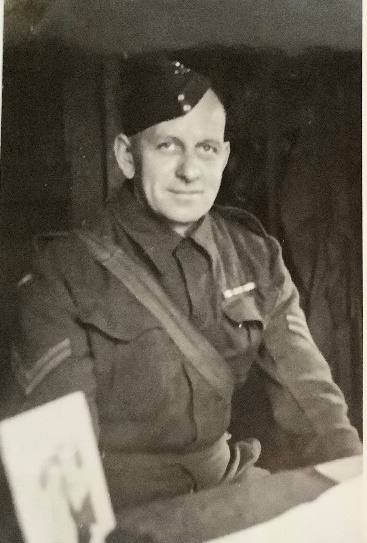
Returning to civilian life, Percy decided to immigrate to Canada. He settled in Timmins, Ontario and worked in the Hollinger Gold Mines. There he built a life, married his sweetheart, Gertrude Reach, and started a family. In 1938, Percy and Gertrude made the unfortunate decision to return to England and start a business. Shortly after, the Second World War broke out, and they made the heartbreaking decision to send their two children, 8-year-old Grace and 7 year-old Percy Jr, back to Canada where they would be safe with friends. Percy enlisted again, this time with the Royal Canadian Artillery in England. He was placed in active service on November 13, 1940 and put his experience to work, training new recruits at Borden Camp in Hampshire. He rose to the rank of Sergeant. His service this time earned him the Canadian Volunteer Service medal and Clasp, the Defence medal and the War Medal 1939-1945.
With the help of his senior officer, Gertrude was able to reunite with their children in Canada in 1942. Assisted by friends, she moved them from Timmins to a new home in Paris, Ontario. She was determined that Percy would never return to the gold mines after the war.
On December 3, 1945, Percy was officially discharged through No. 2 District Depot in Toronto. He then made his way home to Paris, arriving at 2:30 AM. Stepping off the train into the darkness, he had no idea which way to go. He found the main street and approached a police officer for directions. The officer instantly knew who he was, mentioning that a woman had been pacing Grand River Street for hours. Before Percy could take another step, Gertrude, having spotted him from her window, ran out into the street. Their emotional embrace was something neither would ever forget.
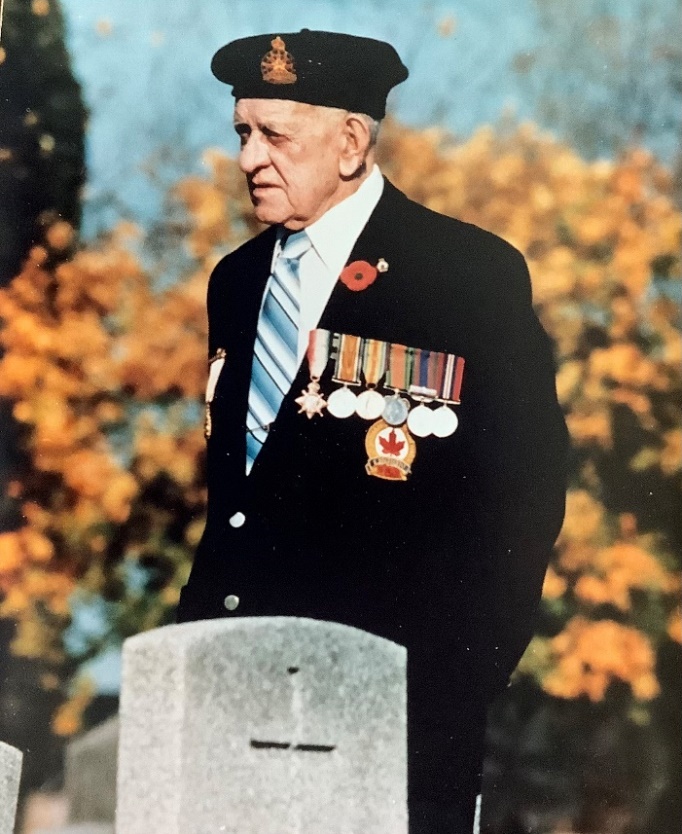
Percy never returned to the gold mines. Instead, he took a job at Consolidated Sand & Gravel and settled into the community. Initially, they rented at 67 Grand River Street, and later at 41 West River Street before he built their final home at 1 Acre Street. He was a devoted family man who loved playing euchre with friends at the Seniors group. He loved to garden. And his bond with horse stayed with him for life. After the war, he always kept sugar cubes in his pocket to feed any horses he encountered. As the years went on and horses disappeared from the streets, he adapted the habit for people, always carrying candy to brighten the day of bank tellers and those he met along the way. He was known as the Candy Man in Paris. Percy was a lifetime member of Royal Canadian Legion Branch 29, and he and never missed a Remembrance Day service.
Sergeant Percy Blackman passed away in 1988 at the age of 89 and lies buried next to his wife in the Paris Cemetery.