
66 William Street
Gunner George Henry Beechey
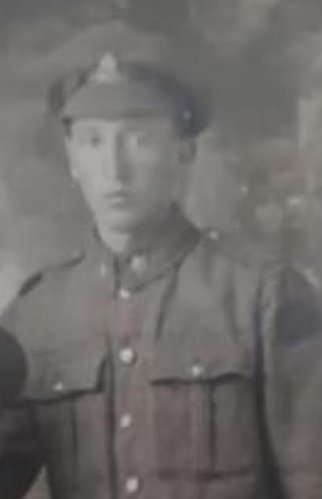
George Beechey was born on July 23, 1893 in Leicestershire, England. He was working as a shipper when he enlisted in Valcartier, Quebec on September 24, 1914 with the 3rd Brigade, Canadian Field Artillery where he served as a gunner.
On August 13, 1915, George suffered a fractured wrist. At this time, the 3rd Brigade, Canadian Field Artillery was serving on the Western Front in the Ypres Salient as part of the 1st Canadian Division. Just months after surviving the brutal 2nd Battle of Ypres, the brigade spent mid-August conducting routine trench harassing fire, counter-battery work, and repelling localized German bombardments near the Yser Canal. George as treated at No. 6 General Hospital near Rouen, then transferred to the Convalescence Depot in Rouen. In August, he was in the Canadian Base Depot and George rejoined his unit in September, 1915. He injured his wrist again in October and returned again to his unit on November 5, 1916.
George found himself in hospital again on January 1, 1917 when he was admitted to No. 11 General Hospital in Camiers with severe contusions to his back. This is likely the time when George was run over by an ammunition wagon which caused severe pain in his back. He was discharged to Details Camp on January 29. He contracted mumps in November, 1917 and was placed in No. 7 Convalescence Hospital for most of January and February, 1918. He was transferred to Brixton in England for further convalescence, pending discharge to Canada. He sailed back to Canada aboard the Royal George from Liverpool and arrived in Halifax on March 25, 1919. He received his final discharge on March 29 in Toronto.
During the Second World War, the Dufferin and Haldimand Rifles of Canada mobilized for active service on May 24, 1940 in a home defence role. The Ministry of National Defense had established a force to be known as the Veteran’s Home Guard for the adequate protection of military property on the home front. The Home Guard would free younger men for overseas duty by replacing the Canadian Provost Corps (the military police of the Canadian Army) guarding facilities such as the 40 internment and pow camps operated across Canada during WW2. George Beechey served in the Home Guard.
He was a life member of Branch 29, Paris Legion and a life member of the Old Timers, Branch 90 Legion in Brantford. He was a life member of the Ex-Imperial Club and the Ozias Lodge, No. 508A.F and A.M.GRC. Gunner George Beechey is buried in the Paris Cemetery.