
Corporal Earle Victor Barker
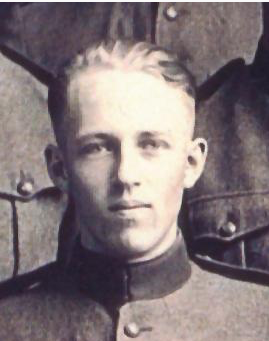
Earle Barker was born on September 20, 1896 in Paris, the son of Clifford B. Barker, who was a sergeant in the 215th Battalion, and Alice Barker. He had three brothers and a sister. Earle was an assistant Boy Scout Master until 1914 when he became Scout Master when his predecessor returned to England to enlist with his battalion. He was also a very active member of the YMCA. Earle was also secretary of the Methodist Sunday School and also sang in the choir. He had been a student at Paris High School and won a medal in 1914 as an all-round athlete. Earle had just graduated at 19 years of age when he enlisted on August 6, 1915 with the 38th Battalion of the Canadian Expeditionary Force. The same month, he was transferred to the 76th Battalion and then the 20th, and went overseas in October as a signaler.
He had been through several engagements prior to 1917, and in one of them he had been wounded. He was present at the Battle of Vimy Ridge. In the spring of 1917, the French and British planned a new offensive in the hope of breaking through the German lines and ending the stalemate. Time was of the essence: all the armies were depleted from years of fighting and struggling to fill their ranks with new recruits. The Russian Revolution was also underway, with the revolutionists threatening to pull Russia (one of the key Allied nations) out of the war. A Russian withdrawal would effectively bring the war to an end in the East, allowing Germany to focus more of its forces on the Western Front.
Vimy Ridge is an unusually prominent, 7 km-long escarpment rising amid the open countryside north of the town of Arras. To the north and east of the ridge are the Douai plain and the important coal mining city of Lens — in 1917 both were occupied by Germany. To the west and south were the British lines and unoccupied France. German forces had been entrenched on the heights of the ridge since nearly the beginning of the war in 1914, despite several attempts to dislodge them. More than 150,000 French soldiers had been killed and wounded in previous efforts to recapture the ridge.
In early 1917, British High Command ordered the Canadian Corps to capture the position as part of a larger spring offensive in the Arras area. In the coming campaign, British forces to the south would have limited success, and the French would fail badly, with many of their units reduced to mutiny. But the Canadian attack against Vimy Ridge would be a spectacular victory by comparison.
Lieutenant-General Sir Julian Byng, the Canadian Corps commander, ordered new tactics for the coming assault. Having learned from the Battle of the Somme, intense training better prepared soldiers for what they might find on the battlefield and helped them to make quick decisions on their own that were still in keeping with the overall plan. Small units and individual soldiers were given much more information about the battle and were expected to exercise initiative in keeping the advance moving, even if their officers were killed or wounded.
In addition, the Canadian planners employed another effective strategy, the creeping barrage. The plan was to direct shellfire just ahead of advancing Canadian troops who slowly moved forward in timed increments. The artillery acted like a moving shield to keep enemy soldiers in their trenches, allowing advancing friendly infantry to follow closely behind, effectively "creeping" across no-man's-land with fewer casualties. A tremendous artillery barrage, which included improved techniques for counter-battery fire against enemy guns, would smash German positions and isolate enemy troops in their dugouts.
At 5:30 a.m. on 9 April 1917, Easter Monday, nearly 1,000 guns opened fire on the German positions. An estimated 15,000 Canadians rose from the trenches and advanced towards the ridge in the first wave, with thousands more behind them. Despite hard fighting all across the front, the Canadians captured most of the ridge on the 9th, and the remaining portions of it by the 12th.
Over four days of bloody fighting, the Canadians had overrun Vimy Ridge at the cost of more than 10,600 killed and wounded. It was the largest territorial advance up to that point in the war. The battle has since become an important symbol for Canada, the place where Canadians from across the country delivered an unprecedented victory, all four divisions of the Canadian Corps fighting together for the first time in the war. The victory at Vimy was a defining event for Canada, considered by many contemporaries and later scholars to be a significant event in Canada’s progress to full independence from Britain.
In a letter home, Earle stated that on Easter day during the fierce fighting at Vimy, he had been three times to the heights of the ridge signaling and had miraculously escaped injury. However, he was killed in action not long after, on May 12, 1917 in France. He was commemorated at the Paris Methodist Church.