
24 Walnut Street
Private Ernest James Barber
Ernest Barber was born in Leicester, England on April 5, 1884. He was the eldest of nine children of James Barber and Emma West. On February 2, 1909 he married Mary Ann Eames in Leicester. A year later, on June 4, 1910, they embarked on the SS Canada in Liverpool, bound for Canada. They disembarked 8 days later and made their way to Paris to join his sister.
Ernest enlisted with the 76th Battalion at Camp Niagara, in Niagara on the Lake. He listed his previous occupation as a butcher and identified his religion as Church of England. The battalion trained at Camp Niagara and then embarked for England on the SS Scandinavian on October 1, 1915. On arrival, Ernest was absorbed into the 39th Reserve Battalion to continue training. In February, 1916, he was transferred to the 21st Battalion and joined the 21st Battalion in La Clytte, Belgium on March 12 where he was employed as a Scout.
The battalion spent the first half of the year holding frontline trenches in the notoriously wet and dangerous Ypres Salient. In late March, the British exploded six massive mines under German lines at St. Eloi. The 21st Battalion was heavily engaged in the ensuing, chaotic month-long battle to hold the water-logged mud craters under relentless German shelling and counterattacks. The operation cost the battalion 127 casualties. In June, the Germans launched a massive bombardment and captured the high ground at Mount Sorrel. The Canadian Corps was thrown into fierce counterattacks to regain the lost positions. The 21st Battalion was heavily involved in these defensive and tactical operations, enduring intense artillery fire and suffering another 116 casualties. While the British launched the primary Somme Offensive on July 1, the 21st Battalion initially remained in Belgium. They engaged in standard trench rotations, continuous repairs, sniping, and conducting night raids to gather intelligence on German lines. However, in late August, the entire Canadian Corps began moving south to the Somme sector in France to relieve exhausted British divisions.
Ernest did not go with the battalion. On September 5, Ernest was admitted to No. 4 Canadian Field Ambulance with a diagnosis of Callused feet. That diagnosis was changed to infected feet at No. 2 General Hospital in Le Trepot, France. He was transferred on September 15 to the Canadian Base Depot in Havre, France. One week later he was classified as unfit for front line duty, but the medical board reclassified him as fit for full duty in December and he returned to the 21st Battalion on January 8. Two weeks
later he was admitted to No. 4 Canadian Field Ambulance and diagnosed with myalgia, then flat feet. From that point he was transferred, admitted and discharged from several hospitals, getting further away from the front lines each time until the end of the war. On May 14, 1919, he embarked on the SS Minnekahda bound for Canada. He received his final discharge in Hamilton on May 25, 1919.
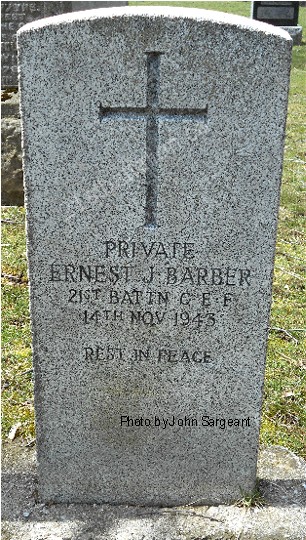
Following his discharge, the British War Medal and the Victory Medal were sent to him in Paris. He and his wife Mary lived at 24 Walnut Street. On November 14, 1943, Private Ernest Barber died of cancer while a patient in the Christie Street Hospital in Toronto. He is buried in the Paris Cemetery.
It is important to note that two of Ernest’s brothers also served in the First World War. His brother Albert also lived in Paris and also served in the Canadian military during the First World War. A younger brother, Joseph Barber, served in the British Army during WW1. Joseph later immigrated to Paris like his older brothers. He had three sons who served during the Second World War. All of their biographies can be found on the Homes of Heroes website.