
11 Gort Street
Stoker First Class Irvine Ambler
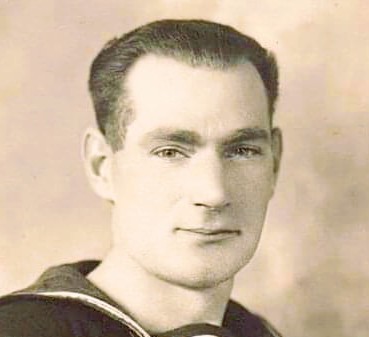
Irvine Ambler was born on June 30, 1913, the sixth child of Irvine Ambler Sr. and Alice Crane Ambler, in Greater Grimsby, Yorkshire, England, at the mouth of the Humber River. His father was a mariner, 1st Engineer on a fishing boat. Irvine Sr. had enlisted in the Royal Navy during the First World War. Irvine Jr. was raised in Cleethorpe, in Greater Grimsby.
Irvine Sr. was a mariner, and he died of septic on January 20, 1921, the result of a marine accident. One month later, on February 22, 1921, Alice Ambler died giving birth to a child who did not survive. In accordance with her wishes that the children be kept together, they all entered the care of the Ex-Servicemen’s Children’s Home in Leeds Yorkshire, where they initially resided. They later became wards of the National Children’s Home (NHC), who sent Irvine to a nautical school in Wales. The charity was founded in 1869 and is still active today, providing various services, including fostering and adoption, family support, and specialist schools. The NCH was involved in child migration schemes, sending children to countries like Canada and Australia, a part of its history for which the charity has formally apologized.
Between 1869 and 1948, more than 100,000 children were sent from Britain to Canada under assisted juvenile emigration schemes. These children, often from impoverished backgrounds, were placed in Canadian homes to provide farm labor or domestic service. While presented as orphans, only about 12% were truly without parents. Many came from families struggling with poverty. Charities like Dr. Barnardo’s, Fegans, and the Salvation Army were heavily involved in such programs. The program shaped Canadian society but also led to hardship, exploitation, and abuse for many children. Today, descendants of British Home Children make up an estimated 10% of Canada’s population, and efforts continue to preserve their stories. Irvine’s is one of those.
On September 20, 1927, Irvine and a group of other orphans boarded R.M.S. Andania bound for Quebec City. The ship’s passenger list says that he planned to be doing farm work. He eventually reached the National Children’s Home in Hamilton where he remained until picked up by the farmer to whom he was indentured. Indentured labour was a system where a person, an "indentured labourer," agreed to work without pay for a set number of years in exchange for a contract, called an "indenture". This contract typically covered the costs of their travel to a new location, as well as housing and food. Often established to replace slave labor after its abolition, the system was frequently exploitative and came with harsh conditions, though it differed from slavery by its contractual basis.
Irvine came to understand this system very well, both the good and the bad. Before he was discharged at 18 years of age from his indentureship, he had six placements in the Princeton/Drumbo area. The first he mentioned to his son “did not have a lot of kindness.” His brother George, who was sent over to Canada earlier, was also in the area under the same circumstances on neighbouring farms. In 1939 they decided to run away. They were quickly rounded up by police and returned. The Inspection Report of March 24, 1930 says, “It appears that he was coaxed away from home by his brother.” Irvine’s last placement, on the other hand, was a happy one. It was at the Cowan farm near Drumbo in 1932 where he wanted to stay another year and finished his farm labour indentureship in 1933. George Ambler returned to England after his indentureship.
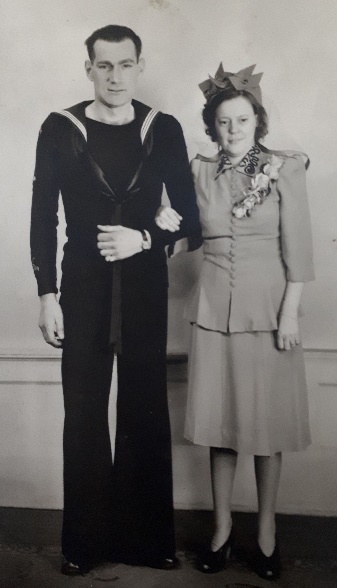
After his indenture, Irvine moved to Paris until the Second World War. He enlisted in the Royal Canadian Navy in Hamilton on May 9, 1942. About this time, at the Sunnyside Amusement Park in Toronto, he met his future wife, Mary Helena Palmer from Madoc, in eastern Ontario. She had moved to Toronto to work. They married on March 2, 1943, with him in his full dress uniform. When he shipped out, Mary moved back to Madoc to be with family.
After his initial training in Kingston, he posted as crew on several ships: HMCS York, HMCS Naden, HMCS Givenchy, and HMCS Cornwallis. He ended on the HMCS Drumheller as Stoker, First Class, performing convoy escort duty in the North Atlantic from July 11, 1943 to June 20, 1945. Merchant ships carrying food, weapons and supplies, sailed in a tight formation, often consisting of dozens or even over a hundred vessels, with a smaller number of escort ships surrounding them. The escort ships provided defense with their guns, torpedoes, and depth charges, and used technology like ASDIC (sonar) to detect and attack submarines. The convoy system was vital for supplying Britain and other Allied nations with essential goods. It made such a difference that less than 30% of ships sunk by U-boats were lost while in a convoy. The Royal Canadian Navy (RCN) played a leading role in escorting convoys for the duration of the war. By 1944–45, the RCN provided most of the close escort for North Atlantic convoys and formed mid-ocean support groups.
Irvine was discharged on October 15, 1945. After the war, Irvine and Mary moved back to Paris where their only child, Donald, was born at the Willett Hospital in 1946. They lived in an apartment above 37 Grand River Street until their brand-new home at 11 Gort Avenue in the Victoria Survey was built.
This neighbourhood came to be known as wartime housing. In a step meant to meet the growing demand for affordable housing, for both defence-related industry workers and returning veterans, the Federal Government jumped into the world of residential development for the first time in the 1940s and Victory Homes were born.
Constructed of prefabricated components (walls and roofs), the homes mimicked the mass production of the war effort. In all, over 30,000 homes were built across Canada under the direction of the Wartime Housing Corporation, later to become Canada Mortgage and Housing Corporation (CMHC) in 1947. Most homes were one storey, with steep pitched roofs and small sash windows. Although some homes had brick exteriors, the majority had clapboard wooden siding. Both centre and side-hall plans were available. The homes typically had an eat-in kitchen, living room, one bathroom and two bedrooms downstairs, with room to expand upstairs into the attic if required. Victory Homes were designed to be comfortable and large enough for a single family. Their unique and recognizable designs have become “classics” in the Canadian urban landscape.
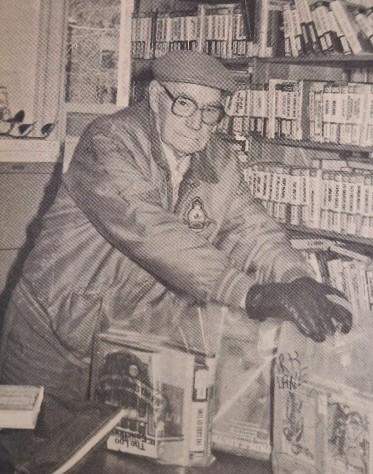
Irvine worked at Medusa Cement from 1940 to 1972. He spent his retirement years doing things to help others. He was a loyal member of the Royal Canadian Legion. He overheard the librarian at the Paris library saying that she needed someone to deliver books to shut-ins and nursing homes and he offered to do that. But he didn’t just drop off the books, he also visited his clients at three nursing homes, the Willett Hospital, the two seniors’ apartment buildings and a few individual homes. He also volunteered at Information Paris.
Irvine Ambler passed away at Telfer Place on August 28, 2002, at the age of 89. Mary Ambler had predeceased him at the Willett Hospital on April 4, 1997, at the age of 77. Both are buried in Hazzard’s Corners Cemetery, Madoc Township, Ontario.