115 Main St South
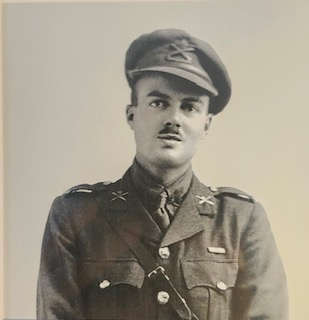
Dr. Vivian Claude Williams
Claude Williams was born on August 17, 1896 in North Hatley Quebec to Rev. George Henry Williams and Gertrude Louise Adams. Claude was the eldest of eight children. The family moved often as Rev. Williams was transferred to various parishes including Quebec City, Winnipeg, Toronto and Hamilton. During high school, Claude’s vision became so poor that his doctor told the family that he would have to leave school to rest his eyes or he would become blind. Unwilling to have his son sit idle, his father apprenticed him to a carpenter for a year.
Claude enrolled in the University of Toronto Medical School in September 1914, just as WW1 was breaking out. He often spoke of the military parades that would take place on campus between classes, to draw in enthusiastic recruits. During his first year at the U. of T., he was enrolled in the Canadian Officers Training Corps.
After one year of studies, Claude enlisted in the army and began training at Camp Niagara. He received a commission as a Lieutenant in the 13th Royal Regiment in June 1915, subsequently joining the 86th Machine Gun Battalion, a private unit funded by Colonel John Labatt and stationed in Hamilton. In May 1916 he was shipped overseas on the RMS Adriatic and trained as a machine gunner. By October he was in France with the 6th Brigade Canadian Machine Gun Corps, British Expeditionary Force. Life in the trenches was unimaginable with continuous shelling, death and destruction, mud, rats and lice, but his letters home were always enthusiastic and full of optimism.
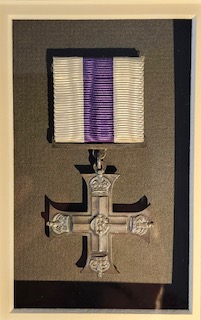
Much secret training was taking place in preparation for the Battle of Vimy Ridge. Both the British and French had tried unsuccessfully to take this strategic ridge over several months. On a snowy Easter Monday, April 9, 1917 the well-planned attack began. Just as the men were to go “over the top”, the Unit’s Captain was killed. The two Lieutenants tossed a coin and Lt. Williams “won”. He led his men through mud and heavy fire arriving at his intended destination with no casualties. For his bravery he was awarded the Military Cross by King George V at Buckingham Palace. The commendation reads: “He fought his guns with utmost skill and energy. Alone and under heavy fire he reconnoitered with the forward positions For his guns which he later pushed forward with much skill”
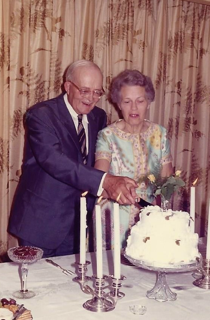
A few months later at the Battle of Hill 70 he suffered gas poisoning and trench fever and was sent to England to recover. Claude returned to France in the spring of 1918 and was promoted to Captain before being repatriated to Canada. Following his return to Canada, Claude resumed his medical studies, graduating in 1922, later marrying Audrey Mary Parlee, a school teacher from New Brunswick, whom he had met in Winnipeg at the church where his father was preacher. They immediately moved to Georgetown to (what is now) 115 Main St South with Claude setting up practice in the old Bank of Hamilton building. Claude was on call 24 hours per day, making house calls in a Model T Ford, and cutter and horse in the snowy winters. His patients remember him as a man devoted to his profession with a gracious manner and cheery smile. He often treated the poor for free and during the depression commonly accepted livestock or produce as payment for his services.
For 30 years he served as Medical Officer of Health and under his leadership, in 1928 Georgetown became the first town in Ontario to make the pasteurization of milk mandatory. He also promoted a sewage system and advised that the town’s drinking water be chlorinated. At the time some of his ideas were controversial, and he lost some patients over them.
He and several other Georgetown veterans were instrumental in forming the Royal Canadian Legion branch in town and he served as its first Vice-President.
Claude tried to enlist at the beginning of WW2, but was one month too old. He was however, involved with the military training at Camp Niagara for three years.
Claude and Audrey had two children, Helen Louise (Williams) Boody and David Parlee Williams (longtime Georgetown resident and owner of Dave Williams Electric and Heating). In 1966 he retired from family practice and with his wife Audrey built a home on the 8th Line. Here he took pride in keeping the grounds and his beloved rose garden in good shape. For several years, he did insurance examinations for the Georgetown Fire Department at his home.
During his years overseas, Claude regularly sent letter home to his family, which his father had typed up. Copies of these letters as well as trunk of artifacts from the war are treasured by members of his family to this day. His letters came to the attention of Pierre Berton when he was researching his book “Vimy” and many references to these letters can be found throughout the book which was published in 1986. On the 90th and 100th anniversaries of the Battle of Vimy Ridge, several members from four generations made the pilgrimage to Vimy in his honour.
Dr. Claude Williams passed away in June 1985 and is buried at Greenwood Cemetery in Georgetown.
Truly a Canadian Hero. His story lives on.
Submitted to Home of Heroes Halton Hills by Joan Medina