8 Line
Brigadier General John Pollands Girvan
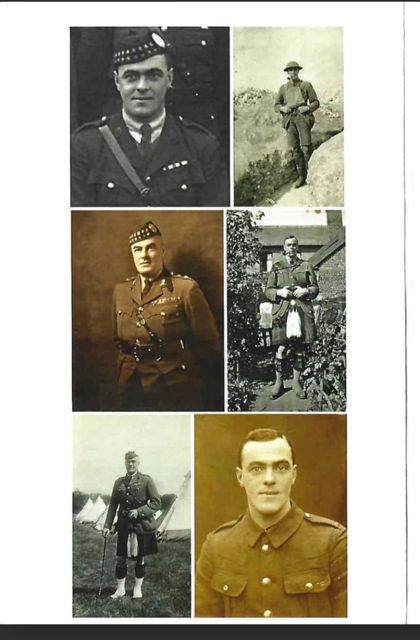
John was born on November 28,1887 in Scotland and educated in Edinburgh. Coming to Canada, he joined the postal service in Toronto, in 1907. He was a fine athlete, a first-rate boxer and won numerous championships as a member of the Argonaut Rowing Club.
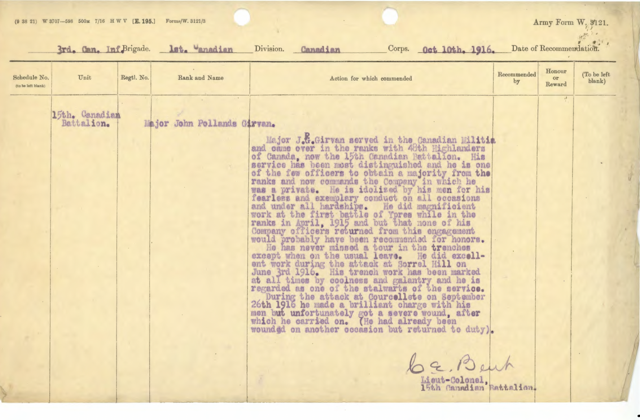
Brigadier J.P. Girvan began his military career as a 27 year old civilian soldier enlisting with the 15th Battalion in September of 1914, sailing overseas with the 1st Contingent. John survived the gas attack during the Battle of Ypres (although 647 men of the 15th did not) and was promoted to the rank of Corporal. Throughout the events of the war, Girvan was promoted to the rank of Lieutenant , continuing into the ranks of Captain and Major. As a Major commanding No 3 Company he was wounded at Courcelette in 1916 by a bullet which penetrated his right chest at the sternum, travelling down to lodge in abdominal muscle. Following his hospitalization he was furloughed to Canada for 3 months (circumstances by which he may have met Nursing Sister Jean Sword). In May 1917, he was awarded the prestigious “Croix de Guerre” Medal.
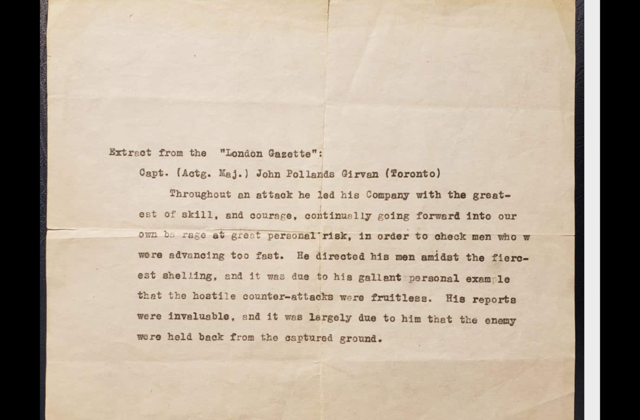
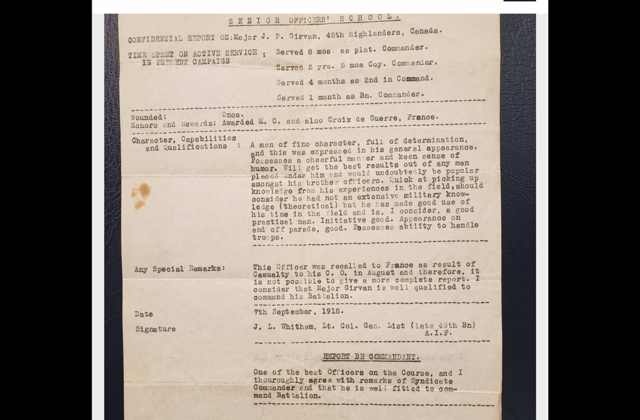
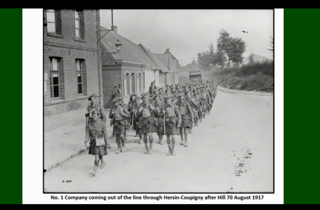
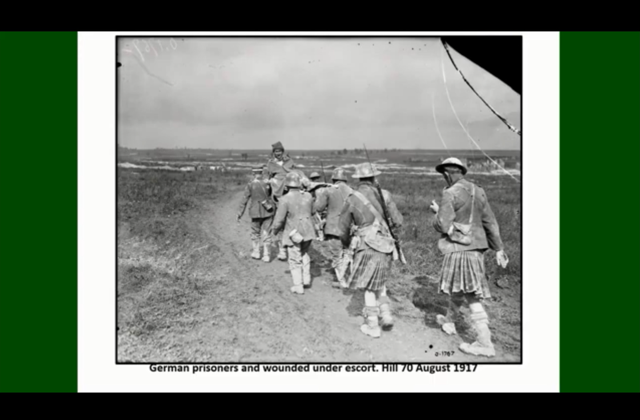
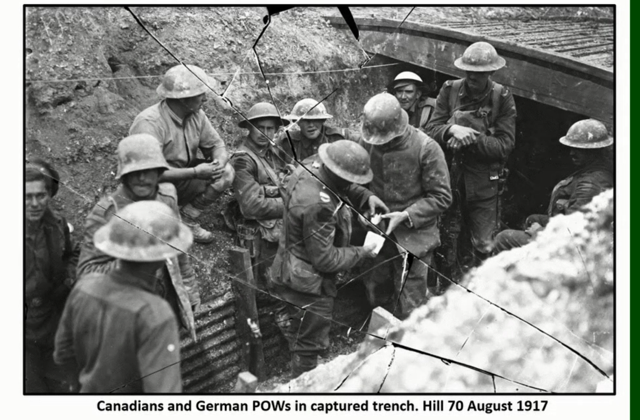
While in command of No 1 Company, having lead the forward assault during the Battle of Hill 70, he was awarded the Military Cross for “conspicuous gallantry and devotion to duty”. He was struck off strength to attend a Command Officers course in London in June 1918 for 8 weeks and it was during this time that he married Nursing Sister Jean Sword. With his Commanding Officer severely wounded, Girvan was called back from his honeymoon, to take command of the 15th and as the Acting Commanding Officer, lead the assault on The Crow’s Nest , quickly capturing and defending the position against German counterattacks. He was awarded an immediate Distinguished Service Award for his actions. While in his command, in September 1918,the Battalion attacked Canal du Nord capturing 300 prisoners, and as a result John was awarded a Bar to his DSO “for marked gallantry and ability”. In October he reverted to Second-in-Command, retaining this position until the end of the Great War. During the last week of the war, the Battalion was in reserve and so saw no further action. Following the Armistice, he had the honour of carrying the Colours of the 15th Battalion into Germany.
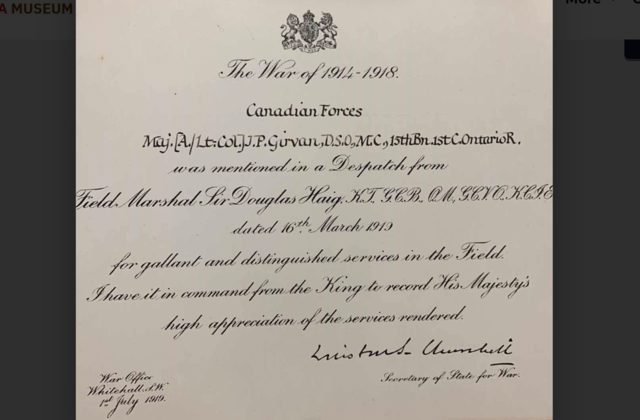
John Pollands Girvan was one of the most highly decorated soldiers of the Canadian Expeditionary Force, mentioned in various Dispatches and highly regarded by the men who served with him. He remained with the 48th Highlanders of Canada post war, commanding the regiment from 1932 to 1936 and once again as Commanding Officer of 2nd Home Battalion of the Highlanders in the Second World War. In 1940, he was appointed C.O. of the 1st Training Centre at Camp Borden in England. In 1943, he was promoted to Brigadier-General and appointed to be Director of Military Training in Ottawa. For his WW2 service he was awarded the Commander of the Order of the British Empire.
As a civilian, Girvan returned to the Post Office in 1919 in the position of Principle Clerk, rising in 1927 to Head Postal Clerk and in 1932 to Superintendent of Mails. In 1936 he was Assistant Postal Director, becoming Postmaster in 1947. He retired in 1948, shortly after he and his wife Jean Elizabeth Sword Girvan purchased property on the 8th Line in Georgetown…living the rest of their lives at the home they referred to as “Wildwood Lodge”.
John Pollands Girvan died at this home in 1961, with his wife Jean dying one year later. John is laid to rest in Greenwood Cemetery, Georgetown.
Truly a Canadian Hero. His story lives on.
Information taken from Vitalcollections.ca, Canadian Expeditionary Force Research Group-the Great War 1914-1918 www.noonans.co.uk, museum.48thhighlanders.ca